Live briefing
Everything about Sequence assembly
Method of DNA sequence reconstruction
In bioinformatics, sequence assembly refers to aligning and merging fragments from a longer DNA sequence in order to reconstruct the original sequence. This is needed as DNA sequencing technology might not be able to 'read' whole genomes in one go, but rather reads small pieces of between 20 and 30,000 bases, depending on the technology used. Typically, the short fragments (reads) result from shotgun sequencing genomic DNA, or gene transcript (ESTs). Wikipedia →
🧭 Start here: a 6-step reading path
- Read the overview: Sequence assemblyA 5-minute orientation
- Skim a recent paper: Gfastats: conversion, evaluation and manipulation of genome sequences using assembly graphsInfluential work since 2022
- Pick up a classic book: TRS-80 assembly language subroutinesThe most-reprinted book on the subject
- Read the landmark paper: SPAdes: A New Genome Assembly Algorithm and Its Applications to Single-Cell SequencingCited 25,692 times
- Go sideways: De novo transcriptome assemblyA closely related topic
- Go sideways: Velvet assemblerA closely related topic
📖 Definitions
Noun The aligning and merging of fragments from a longer DNA sequence in order to reconstruct the original sequence.
🗂️ The subject at a glance
🏆 Landmark papers (most cited)
SPAdes: A New Genome Assembly Algorithm and Its Applications to Single-Cell Sequencing
CAP3: A DNA Sequence Assembly Program
A new DNA sequence assembly program
Tablet—next generation sequence assembly visualization
Sequence assembly demystified
Combinatorial algorithms for DNA sequence assembly
Next Generation Sequence Assembly with AMOS
An Improved Sequence Assembly Program
🆕 Influential since 2022
Gfastats: conversion, evaluation and manipulation of genome sequences using assembly graphs
HiFiAdapterFilt, a memory efficient read processing pipeline, prevents occurrence of adapter sequence in PacBio HiFi reads and their negative impacts on genome assembly
Algorithm for DNA sequence assembly by quantum annealing
Reverse Sequence Polymerization‐Induced Self‐Assembly in Aqueous Media
Assembly-Oriented Task Sequence Planning for a Dual-Arm Robot
📚 Books worth reading
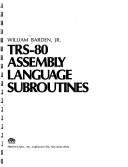 TRS-80 assembly language subroutinesWilliam T. Barden · 1982
Ranked by number of editions on Open Library, a rough measure of how lasting a book is.
🔗 Related topics
- De novo transcriptome assembly De novo transcriptome assembly is the de novo sequence assembly method of creating a transcriptome without the aid of a reference genome. As a result of…
- Velvet assembler Velvet is an algorithm package that has been designed to deal with de novo genome assembly and short read sequencing alignments. This is achieved through…
- Hybrid genome assembly In bioinformatics, hybrid genome assembly refers to utilizing various sequencing technologies to achieve the task of assembling a genome from fragmented…
- De novo sequence assemblers De novo sequence assemblers are a type of program that assembles short nucleotide sequences into longer ones without the use of a reference genome. These…
- Read (biology) In DNA sequencing, a read is an inferred sequence of base pairs (or base pair probabilities) corresponding to all or part of a single DNA fragment. A typical…
- Scaffolding (bioinformatics) Scaffolding is a technique used in bioinformatics. It is defined as follows: Link together a non-contiguous series of genomic sequences into a scaffold…
- List of RNA-Seq bioinformatics tools RNA-Seq is a technique that allows transcriptome studies (see also Transcriptomics technologies) based on next-generation sequencing technologies. This…
- SPAdes (software) SPAdes (St. Petersburg genome assembler) is a genome assembly algorithm which was designed for single cell and multi-cells bacterial data sets. Therefore…