Everything about Semiorder
Numerical ordering with a margin of error

In order theory, a branch of mathematics, a semiorder is a type of ordering for items with numerical scores, where items with widely differing scores are compared by their scores and where scores within a given margin of error are deemed incomparable. Semiorders were introduced and applied in mathematical psychology by Duncan Luce as a model of human preference. They generalize strict weak orderings, in which items with equal scores may be tied but there is no margin of error. They are a special case of partial orders and of interval orders, and can be characterized among the partial orders by additional axioms, or by two forbidden four-item suborders. Wikipedia →
🧭 Start here: a 6-step reading path
- Read the overview: SemiorderA 5-minute orientation
- Skim a recent paper: True and error analysis instead of test of correlated proportions: Can we save lexicographic semiorder models with error theory?Influential work since 2022
- Pick up a classic book: L.V. Kantorovich selected worksThe most-reprinted book on the subject
- Read the landmark paper: Transition from semiorder to disorder in the aggregation of dense colloidal solutionsCited 103 times
- Go sideways: Pseudo-orderA closely related topic
- Go sideways: Weak orderingA closely related topic
📖 Definitions
Noun A type of order that is not wholly comparable
🗂️ The subject at a glance
🏆 Landmark papers (most cited)
Transition from semiorder to disorder in the aggregation of dense colloidal solutions
Continuous semiorder representations
Minimal representation of a semiorder
Sub-semiorder: A model of multidimensional choice with preference intransitivity
A lexicographic semiorder polytope and probabilistic representations of choice
Synthetic description of a semiorder
On the separation of in vivo relations by a biorder or a semiorder
Semiorder preferences and price-oriented buyers in a Hotelling model
🆕 Influential since 2022
📚 Books worth reading
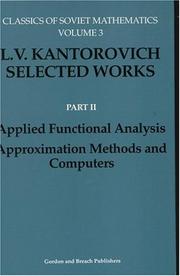 L.V. Kantorovich selected worksL. V. Kantorovich, Raymond Bonnett · 1996
- 📕SemiordersMarc Pirlot, P. Vincke · 2013
 SemiordersM. Pirlot · 1997
 SemiordersM. Pirlot · 1997
- 📕Semi-ordered linear spacesHidegorô Nakano · 1955
- 📕Modulared semi-ordered linear spacesHidegoro Nakano · 1950
- 📕Modulared semi-ordered linear spacesHidegorō Nakano · 1950
- 📕Semi-ordered linear spacesHidegorō Nakano · 1955
Ranked by number of editions on Open Library, a rough measure of how lasting a book is.
🔗 Related topics
- Pseudo-order In constructive mathematics, pseudo-order is a name given to certain binary relations appropriate for modeling continuous orderings. In classical mathematics…
- Weak ordering In order theory, a weak ordering is a mathematical formalization of the intuitive notion of a ranking of a set, some of whose members may be tied with…
- Partially ordered set In mathematics, especially order theory, a partial order on a set is an arrangement such that, for certain pairs of elements, one precedes the other. The…
- Linear extension In order theory, a branch of mathematics, a linear extension of a partial order is a total order (or linear order) that is compatible with the partial…
- Szpilrajn extension theorem In order theory, the Szpilrajn extension theorem (also called the order-extension principle), proved by Edward Szpilrajn in 1930, states that every partial…
- Comparability Look up comparability in Wiktionary, the free dictionary. In mathematics, two elements x and y of a set P are said to be comparable with respect to a binary…
- Order dimension In mathematics, the dimension of a partially ordered set (poset) is the smallest number of total orders the intersection of which gives rise to the partial…
- Inclusion order In the mathematical field of order theory, an inclusion order is the partial order that arises as the subset-inclusion relation on some collection of objects…