Everything about Second quantization
Formulation of the quantum many-body problem

Second quantization, also referred to as occupation number representation, is a formalism used to describe and analyze quantum many-body systems. In quantum field theory, it is known as canonical quantization, in which the fields are thought of as field operators, in a manner similar to how the physical quantities are thought of as operators in first quantization. The key ideas of this method were introduced in 1927 by Paul Dirac, and were later developed, most notably, by Pascual Jordan and Vladimir Fock. In this approach, the quantum many-body states are represented in the Fock state basis, which are constructed by filling up each single-particle state with a certain number of identical particles. The second quantization formalism introduces the creation and annihilation operators to construct and handle the Fock states, providing useful tools to the study of the quantum many-body theory. Wikipedia →
🧭 Start here: a 6-step reading path
- Read the overview: Second quantizationA 5-minute orientation
- Skim a recent paper: Quantum computation for periodic solids in second quantizationInfluential work since 2022
- Pick up a classic book: The Elements of Statistical LearningThe most-reprinted book on the subject
- Read the landmark paper: Second quantization in the Kerr metricCited 235 times
- Go sideways: Glossary of elementary quantum mechanicsA closely related topic
- Go sideways: Anti-symmetric operatorA closely related topic
📖 Definitions
No dictionary entry for this exact phrase.
🏆 Landmark papers (most cited)
Second quantization in the Kerr metric
Twisted second quantization
The mathematics of second quantization
Quasi-free “second quantization”
Entanglement in the second quantization formalism
Covariant second quantization of free superstring
Covariant second quantization of superstrings
Symplectic geometry and second quantization
🆕 Influential since 2022
Quantum computation for periodic solids in second quantization
Adaptive Finite-time Consensus for Second-order Nonlinear Multi-agent Systems with Input Quantization
A Second-Order NS Pipelined SAR ADC With Quantization-Prediction-Unrolled Gain Error Shaping and Fully Passive Integrator
Tight-binding Model in First and Second Quantization for Band Structure Calculations
Second quantization of many-body dispersion interactions for chemical and biological systems
📚 Books worth reading
 The Elements of Statistical LearningTrevor Hastie, Robert Tibshirani · 2001
 The stability of matter in quantum mechanicsElliott H. Lieb · 2009
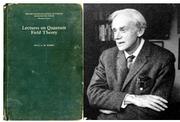 Lectures on quantum field theoryPaul Adrian Maurice Dirac · 1966
- 📕Structural Aspects of Quantum Field Theory and Noncommutative GeometryGerhard Grensing · 2013
 Second quantization and atomic spectroscopyBrian R. Judd · 1967
 Second quantization-based methods in quantum chemistryPoul Jørgensen, Poul Jorgensen · 1981
 The Method of second quantizationFelix Berezin · 1966
 Introduction to SuperstringsMichio Kaku · 1988
Ranked by number of editions on Open Library, a rough measure of how lasting a book is.
🔗 Related topics
- Glossary of elementary quantum mechanics This is a glossary for the terminology often encountered in undergraduate quantum mechanics courses. Cautions: Different authors may have different definitions…
- Anti-symmetric operator In quantum mechanics, a raising or lowering operator (collectively known as ladder operators) is an operator that increases or decreases the eigenvalue…
- Fermionic field In quantum field theory, a fermionic field is a quantum field whose quanta are fermions; that is, they obey Fermi–Dirac statistics. Fermionic fields obey…
- Schrödinger field In quantum mechanics and quantum field theory, a Schrödinger field, named after Erwin Schrödinger, is a quantum field which obeys the Schrödinger equation…
- Spin 1/2 In quantum mechanics, spin is an intrinsic property of all elementary particles. All known fermions, the particles that constitute ordinary matter, have…
- Time-evolving block decimation The time-evolving block decimation (TEBD) algorithm is a numerical scheme used to simulate one-dimensional quantum many-body systems, characterized by…
- Displacement operator In the quantum mechanics study of optical phase space, the displacement operator for one mode is the shift operator in quantum optics, D ^ ( α ) = exp…
- Slater determinant In quantum mechanics, a Slater determinant is an expression that describes the wave function of a multi-fermionic system. It satisfies anti-symmetry requirement…