Live briefing
Everything about SLD resolution
Rule in logic programming
SLD resolution is the basic inference rule used in logic programming. It is a refinement of resolution that is both sound and refutation complete for Horn clauses. Wikipedia →
🧭 Start here: a 6-step reading path
- Read the overview: SLD resolutionA 5-minute orientation
- Pick up a classic book: Neuroimaging of Sleep and Sleep DisordersThe most-reprinted book on the subject
- Read the landmark paper: Approximate reasoning by similarity-based SLD resolutionCited 85 times
- Go sideways: Answer set programmingA closely related topic
- Go sideways: Conflict-driven clause learningA closely related topic
📖 Definitions
No dictionary entry for this exact phrase.
🏆 Landmark papers (most cited)
Approximate reasoning by similarity-based SLD resolution
Narrowing vs. SLD-resolution
Extending SLD resolution to equational horn clauses using E-unification
Similarity-based SLD resolution and its role for web knowledge discovery
Heterogeneous SLD resolution
Initial impact parameter resolution of the new SLD vertex detector
Applying SLD-Resolution to a Class of Non-Horn Logic Programs
A Full Formalization of SLD-Resolution in the Calculus of Inductive Constructions
📚 Books worth reading
 Neuroimaging of Sleep and Sleep DisordersEric Nofzinger · 2013
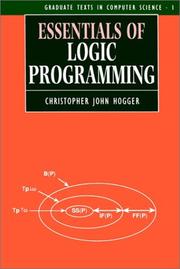 Essentials of logic programmingChristopher John Hogger · 1990
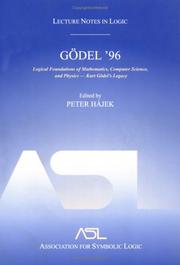 Gödel '96Czech Republic) Godel 9 (1996 Brno, Godel 96 · 2000
Ranked by number of editions on Open Library, a rough measure of how lasting a book is.
🔗 Related topics
- Answer set programming Answer set programming (ASP) is a form of declarative programming oriented towards difficult (primarily NP-hard) search problems. It is based on the stable…
- Conflict-driven clause learning In computer science, conflict-driven clause learning (CDCL) is an algorithm for solving the Boolean satisfiability problem (SAT). Given a Boolean formula…
- Logic programming Logic programming is a programming, database, and knowledge representation paradigm based on formal logic. A logic program is a set of sentences in logical…
- Proof compression In proof theory, an area of mathematical logic, proof compression is the problem of algorithmically compressing formal proofs. The developed algorithms…
- Tseytin transformation The Tseytin transformation, alternatively written Tseitin transformation, takes as input an arbitrary combinatorial logic circuit and produces an equisatisfiabl…
- Horn clause In mathematical logic and logic programming, a Horn clause is a logical formula of a particular rule-like form that gives it useful properties for use…
- DPLL algorithm In logic and computer science, the Davis–Putnam–Logemann–Loveland (DPLL) algorithm is a complete, backtracking-based search algorithm for deciding the…
- Resolution proof compression by splitting In mathematical logic, proof compression by splitting is an algorithm that operates as a post-process on resolution proofs. It was proposed by Scott Cotton…