Everything about Radar
Object detection system using radio waves

Radar is a system that uses radio waves to determine the distance (ranging), direction, and radial velocity of objects relative to the site. It is a radiodetermination method used to detect and track aircraft, ships, spacecraft, guided missiles, motor vehicles, weather formations and terrain. The term RADAR was coined in 1940 by the United States Navy as an acronym for "radio detection and ranging". The term radar has since entered English and other languages as an anacronym, a common noun, losing all capitalization. Wikipedia →
🧭 Start here: a 6-step reading path
- Read the overview: RadarA 5-minute orientation
- Skim a recent paper: Enabling Joint Communication and Radar Sensing in Mobile Networks—A SurveyInfluential work since 2022
- Pick up a classic book: Introduction to Airborne RadarThe most-reprinted book on the subject
- Read the landmark paper: The Shuttle Radar Topography MissionCited 7,436 times
- Go sideways: Pulse-Doppler radarA closely related topic
- Go sideways: Radar engineeringA closely related topic
📖 Definitions
Noun In full primary radar: a method of detecting a distant object and determining its position, velocity, or other characteristics by analysing radio waves (usually microwaves) which are sent towards the object and which reflect off its surfaces; also, the field of study of this method.
Noun In full secondary radar: a method of detecting a distant object and determining its position, velocity, or other characteristics by analysing signals transmitted by the object in response to radio waves sent towards the object.
Noun Often preceded by a descriptive word: a system using one of the above detection methods, differentiated by configuration or platform, frequency, power, and other technical attributes.
Noun An installation of the apparatus for operating one of the above detection systems.
🗂️ The subject at a glance
🏆 Landmark papers (most cited)
The Shuttle Radar Topography Mission
A tutorial on synthetic aperture radar
MIMO Radar with Colocated Antennas
Radar interferometry and its application to changes in the Earth's surface
A review of target decomposition theorems in radar polarimetry
Synthetic aperture radar interferometry
Satellite radar interferometry: Two‐dimensional phase unwrapping
Decorrelation in interferometric radar echoes
🆕 Influential since 2022
Enabling Joint Communication and Radar Sensing in Mobile Networks—A Survey
Cramér-Rao Bound Optimization for Joint Radar-Communication Beamforming
Broadband multispectral compatible absorbers for radar, infrared and visible stealth application
Carbon‐Based Radar Absorbing Materials toward Stealth Technologies
The Surface Water and Ocean Topography Mission: A Breakthrough in Radar Remote Sensing of the Ocean and Land Surface Water
📚 Books worth reading
 Introduction to Airborne RadarGeorge W. Stimson, George W Stimson · 1983
- 📕The first WSR-88D Users' ConferenceWSR-88D Users' Conference (1st 1994 Norman, Okla.) · 1994
 Radar MeteorologyRobert M. Rauber, Stephen L. Nesbitt · 2018
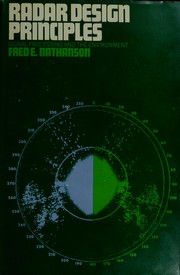 Radar Design PrinciplesFred E. Nathanson · 1969
 Radar and ARPA manualA. G. Bole · 1990
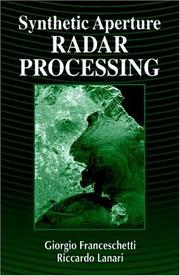 Synthetic aperture radar processingGiorgio Franceschetti · 1999
 Radar daysBowen, E. G. · 1987
 Radar range-performance analysisLamont V. Blake · 1980
Ranked by number of editions on Open Library, a rough measure of how lasting a book is.
🔗 Related topics
- Pulse-Doppler radar A pulse-Doppler radar is a radar system that determines the range to a target using pulse-timing techniques, and uses the Doppler effect of the returned…
- Radar engineering Radar engineering is the design of technical aspects pertaining to the components of a radar and their ability to detect the return energy from moving…
- Radar signal characteristics A radar system uses a radio-frequency electromagnetic signal reflected from a target to determine information about that target. In any radar system, the…
- Moving target indication Moving target indication (MTI) is a mode of operation of a radar to discriminate a target against the clutter. It describes a variety of techniques used…
- Continuous-wave radar Transmitter transmitted energy Receiver backscattered energy, containing much information about the backscatterer Continuous-wave radar (CW radar) is a…
- Low-probability-of-intercept radar A low-probability-of-intercept radar (LPIR) is a radar employing measures to avoid detection by passive radar detection equipment (such as a radar warning…
- Doppler radar A Doppler radar is a specialized radar that uses the Doppler effect to produce velocity data about objects at a distance. It does this by bouncing a microwave…
- Passive radar Passive radar (also referred to as parasitic radar, passive coherent location, passive surveillance, and passive covert radar) is a class of radar systems…