Live briefing

Everything about Quiddity
Essence or inherent nature of thing
In scholastic philosophy, "quiddity" is another term for the essence of an object, literally its "whatness" or "what it is". Wikipedia →
🧭 Start here: a 6-step reading path
- Read the overview: QuiddityA 5-minute orientation
- Skim a recent paper: Existence and the Problem of Aḥwāl: The Quiddity and Ontological Status of Existence in Avicenna and His Islamic ReceptionInfluential work since 2022
- Pick up a classic book: QuidditiesThe most-reprinted book on the subject
- Read the landmark paper: Evidence for Locally Produced, Naturally Accountable Phenomena of Order, Logic, Reason, Meaning, Method, etc. In and as of the Essential Quiddity of Immortal Ordinary Society, (I of IV): An Announcement of StudiesCited 152 times
- Go sideways: HaecceityA closely related topic
- Go sideways: EssenceA closely related topic
📖 Definitions
Noun The essence or inherent nature of a person or thing.
Noun A trifle; a nicety or quibble.
Noun An eccentricity; an odd feature.
🗂️ The subject at a glance
🏆 Landmark papers (most cited)
Evidence for Locally Produced, Naturally Accountable Phenomena of Order, Logic, Reason, Meaning, Method, etc. In and as of the Essential Quiddity of Immortal Ordinary Society, (I of IV): An Announcement of Studies
Families and Networks of Internet Memes: The Relationship Between Cohesiveness, Uniqueness, and Quiddity Concreteness
What do coaches orchestrate? Unravelling the ‘quiddity’ of practice
Quiddity and Real Distinction in St Thomas Aquinas
The Quiddity of the Head Louse
The brain-mind quiddity: ethical issues in the use of human brain tissue for therapeutic and scientific purposes.
Existence (wujūd) and Quiddity (māhiyyah) in Islamic Philosophy
The Quiddity of Mercy
🆕 Influential since 2022
Existence and the Problem of Aḥwāl: The Quiddity and Ontological Status of Existence in Avicenna and His Islamic Reception
A. S. Byatt and the quiddity of things: a material-semiotic approach to narrating the human through the non-human
Quiddity College: Thomas Jefferson's Legacy for Moral Science
Gold, Its Quiddity, and India’s Social Development
Damien Janos. Avicenna on the Ontology of Pure Quiddity
📚 Books worth reading
 QuidditiesAdam Fieled · 2009
 Apparition Poem #1613Adam Fieled · 2010
- 📕Hanklyn-janklin, or, A stranger's rumble-tumble guide to some words, customs and quiddities Indian and Indo-BritishNigel B. Hankin · 1992
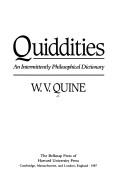 QuidditiesWillard Van Orman Quine · 1987
- 📕Avicenna on the Ontology of Pure QuiddityDamien Janos · 2020
 The Doctrine of Quiddities and Modes in Francis of Meyronnes; Volume 2Caird Alfred Page · 2018
 Hanklyn-janklinNigel B. Hankin · 1997
- 📕The quiddity ofSetofimSebastian Joris · 1972
Ranked by number of editions on Open Library, a rough measure of how lasting a book is.
🔗 Related topics
- Haecceity Haecceity (/hɛkˈsiːɪti, hiːk-/; from the Latin haecceitas, 'thisness') is a term from medieval scholastic philosophy, coined by followers of Duns Scotus…
- Essence Essence (Latin: essentia) has various meanings and uses for different thinkers and in different contexts. It is used in philosophy and theology as a designation…
- Categories (Aristotle) The Categories (Ancient Greek: Κατηγορίαι, romanized: Katēgoriai; Latin: Categoriae or Praedicamenta) is a text from Aristotle's Organon that enumerates…
- Ousia Ousia (/ˈuːziə, ˈuːsiə, ˈuːʒə, ˈuːʃə/; Ancient Greek: οὐσία) is a philosophical and theological term, originally used in ancient Greek philosophy, then…
- Principle of individuation The principle of individuation is a criterion that individuates or numerically distinguishes the members of the kind for which it is given, that is by…
- Substance theory Substance theory, or substance–attribute theory, is an ontological theory positing that objects are constituted each by a substance and properties borne…
- Metaphysics (Aristotle) Metaphysics (Greek: τὰ μετὰ τὰ φυσικά, "those after the physics"; Latin: Metaphysica) is one of the principal works of Aristotle, in which he develops…
- Posterior Analytics The Posterior Analytics (Ancient Greek: Ἀναλυτικὰ Ὕστερα; Latin: Analytica Posteriora) is a text from Aristotle's Organon that deals with demonstration…