Live briefing
Everything about Quantum cryptography
Cryptography based on quantum mechanical phenomena
Quantum cryptography is the exploiting of quantum-mechanical properties such as quantum entanglement, measurement disturbance, no-cloning theorem, and the principle of superposition to perform encryption tasks. Quantum encryption plays a crucial role in the secure processing, storage, and transmission of information. Wikipedia →
🧭 Start here: a 6-step reading path
- Read the overview: Quantum cryptographyA 5-minute orientation
- Skim a recent paper: Security in quantum cryptographyInfluential work since 2022
- Pick up a classic book: Quantum Information TheoryThe most-reprinted book on the subject
- Read the landmark paper: Quantum cryptography based on Bell’s theoremCited 9,625 times
- Go sideways: Relativistic quantum cryptographyA closely related topic
- Go sideways: Quantum key distributionA closely related topic
📖 Definitions
Noun The science of exploiting quantum mechanical properties to perform cryptographic tasks.
🏆 Landmark papers (most cited)
Quantum cryptography based on Bell’s theorem
Quantum cryptography
Advances in quantum cryptography
Experimental quantum cryptography
Post-quantum cryptography
Quantum Cryptography
Quantum cryptography beyond quantum key distribution
Counterfactual Quantum Cryptography
🆕 Influential since 2022
📚 Books worth reading
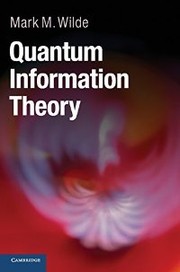 Quantum Information TheoryMark M. Wilde · 2013
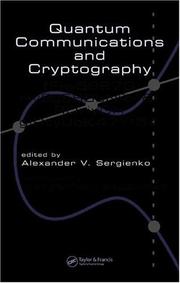 Quantum communications and cryptographyAlexander V. Sergienko · 2005
 Quantum Cryptography and Secret-Key DistillationGilles Van Assche, GILLES VAN ASSCHE · 2006
- 📕Quantum ComputingNational Academies of Sciences, Engineering, and Medicine, Division on Engineering and Physical Sciences · 2019
 Post-Quantum CryptographyTanja Lange, Tsuyoshi Takagi · 2016
 Theory of quantum computation, communication, and cryptographyTQC 2008 (2008 Tokyo, Japan) · 2008
- 📕Kvantovai︠a︡ kriptografii︠a︡ · 2007
 Quantum information and computation : 21-22 April, 2003, Orlando, Florida[name missing] · 2003
Ranked by number of editions on Open Library, a rough measure of how lasting a book is.
🔗 Related topics
- Relativistic quantum cryptography Relativistic quantum cryptography is a sub-field of quantum cryptography, in which in addition to exploiting the principles of quantum physics, the no-superlumi…
- Quantum key distribution Quantum key distribution (QKD) is a secure communication method that implements a cryptographic protocol based on the laws of quantum mechanics, specifically…
- Six-state protocol The six-state protocol (SSP) is the quantum cryptography protocol that is the version of BB84 that uses a six-state polarization scheme on three orthogonal…
- Decoy state In quantum cryptography, a decoy state protocol is a quantum key distribution (QKD) scheme. Practical QKD systems use multi-photon sources, in contrast…
- Noisy-storage model The noisy-storage model refers to a cryptographic model employed in quantum cryptography. It assumes that the quantum memory device of an attacker (adversary)…
- BB84 The BB84 protocol, invented in 1984 by Charles Bennett and Gilles Brassard who later won the 2025 ACM A.M. Turing Award for their invention, is a prepare-and-me…
- BBM92 protocol BBM92 is a quantum key distribution (QKD) protocol named after Charles H. Bennett, Gilles Brassard and N. David Mermin in 1992. The BBM92 is an entanglement…
- Adrian Kent Adrian Kent is a British theoretical physicist. He is a professor at the University of Cambridge, member of the Centre for Quantum Information and Foundations…