Everything about Propositional logic
Branch of logic
Propositional logic is a branch of classical logic. It is also called statement logic, sentential calculus, propositional calculus, sentential logic, or sometimes zeroth-order logic. Sometimes, it is called first-order propositional logic to contrast it with System F, but it is distinct from first-order logic. It deals with propositions and relations between propositions, including the construction of arguments based on them. Compound propositions are formed by connecting propositions by logical connectives representing the truth functions of conjunction, disjunction, implication, biconditional, and negation. Some sources include other connectives, as in the table below. Wikipedia →
🧭 Start here: a 6-step reading path
- Read the overview: Propositional logicA 5-minute orientation
- Skim a recent paper: Relevant propositional dynamic logicInfluential work since 2022
- Pick up a classic book: Philosophische GrammatikThe most-reprinted book on the subject
- Read the landmark paper: Propositional Lax LogicCited 105 times
- Go sideways: First-order logicA closely related topic
- Go sideways: Interpretation (logic)A closely related topic
📖 Definitions
Noun A formal deductive system in which formulae representing propositions can be formed by combining atomic propositions using logical connectives.
🏆 Landmark papers (most cited)
Propositional Lax Logic
L-valued propositional logic Lvpl
Non-commutative Łukasiewicz propositional logic
Propositional computability logic II
Propositional computability logic I
Propositional Abduction in Modal Logic
Partiality and games: propositional logic
Equational propositional logic
🆕 Influential since 2022
📚 Books worth reading
 Philosophische GrammatikLudwig Wittgenstein · 1960
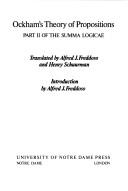 Summa logicaeWilliam of Ockham · 1951
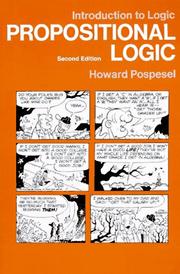 Propositional Logic (Introduction to Logic)Howard Pospesel, William G. Lycan · 1974
 Advocacy and oppositionKaryn C. Rybacki, Kathryn C. Rybacki · 1986
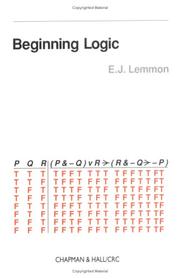 Beginning logicE. J. Lemmon · 1965
 Concept and objectAnthony Palmer · 1988
 Thought and WorldChristopher S. Hill · 2002
 Logica magnaPaolo Veneto · 1499
Ranked by number of editions on Open Library, a rough measure of how lasting a book is.
🔗 Related topics
- First-order logic In mathematics, philosophy, linguistics, and computer science, first-order logic (FOL), also called predicate logic, predicate calculus, or quantificational…
- Interpretation (logic) An interpretation is an assignment of meaning to the symbols of a formal language. Many formal languages used in mathematics, logic, and theoretical computer…
- Natural deduction In logic and proof theory, natural deduction is a kind of proof calculus in which logical reasoning is expressed by inference rules closely related to…
- Truth function In logic, a truth function is a function that accepts truth values as input and produces a unique truth value as output. In other words: the input and…
- Glossary of logic Look up Appendix:Glossary of logic in Wiktionary, the free dictionary. This is a glossary of logic. Logic is the study of the principles of valid reasoning…
- Well-formed formula In mathematical logic, propositional logic, and predicate logic, a well-formed formula, abbreviated WFF or wff, often simply formula, is a finite sequence…
- Proof-theoretic semantics Proof-theoretic semantics is a branch of proof theory and an approach to the semantics of logic in which the meaning of propositions and logical connectives…
- Validity (logic) In logic, specifically in deductive reasoning, an argument is valid if and only if it takes a form that makes it impossible for the premises to be true…