Everything about Primitive equations
Equations to approximate global atmospheric flow
The primitive equations are a set of nonlinear partial differential equations that are used to approximate global atmospheric flow and are used in most atmospheric models. They consist of three main sets of balance equations:A continuity equation: Representing the conservation of mass. Conservation of momentum: Consisting of a form of the Navier–Stokes equations that describe hydrodynamical flow on the surface of a sphere under the assumption that vertical motion is much smaller than horizontal motion (hydrostasis) and that the fluid layer depth is small compared to the radius of the sphere A thermal energy equation: Relating the overall temperature of the system to heat sources and sinks Wikipedia →
🧭 Start here: a 6-step reading path
- Read the overview: Primitive equationsA 5-minute orientation
- Skim a recent paper: The primitive equations approximation of the anisotropic horizontally viscous 3D Navier-Stokes equationsInfluential work since 2022
- Pick up a classic book: A Treatise on Differential Equations: Supplementary VolumeThe most-reprinted book on the subject
- Read the landmark paper: Vertical Differencing of the Primitive Equations in Sigma CoordinatesCited 120 times
- Go sideways: First law of thermodynamics (fluid mechanics)A closely related topic
- Go sideways: Toroidal coordinatesA closely related topic
📖 Definitions
No dictionary entry for this exact phrase.
🏆 Landmark papers (most cited)
Vertical Differencing of the Primitive Equations in Sigma Coordinates
Conservation laws for primitive equations models with inhomogeneous layers
Anisotropic estimates and strong solutions of the primitive equations
Fractional equations with bounded primitive
Open Boundary Conditions for the Primitive and Boussinesq Equations
Primitive equations with continuous initial data
GENERAL CIRCULATION EXPERIMENTS WITH THE PRIMITIVE EQUATIONS
Large deviation principles for 3D stochastic primitive equations
🆕 Influential since 2022
The primitive equations approximation of the anisotropic horizontally viscous 3D Navier-Stokes equations
Self-attraction and loading feedback on ocean dynamics in both shallow water equations and primitive equations
PEPNet: A barotropic primitive equations-based network for wind speed prediction
Higher-order error estimates for physics-informed neural networks approximating the primitive equations
The stochastic primitive equations with transport noise and turbulent pressure
📚 Books worth reading
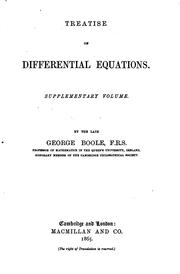 A Treatise on Differential Equations: Supplementary VolumeGeorge Boole, Isaac Todhunter · 1865
Ranked by number of editions on Open Library, a rough measure of how lasting a book is.
🔗 Related topics
- First law of thermodynamics (fluid mechanics) In physics, the first law of thermodynamics is an expression of the conservation of total energy of a system. The increase of the energy of a system is…
- Toroidal coordinates Toroidal coordinates are a three-dimensional orthogonal coordinate system that results from rotating the two-dimensional bipolar coordinate system about…
- Euler equations (fluid dynamics) In fluid dynamics, the Euler equations are a set of partial differential equations governing adiabatic and inviscid flow. They are named after Leonhard…
- Q-Vectors Q-vectors are used in atmospheric dynamics to understand physical processes such as vertical motion and frontogenesis. Q-vectors are not physical quantities…
- Electric dipole transition An electric dipole transition is the dominant effect of an interaction of an electron in an atom with the electromagnetic field. Following the reference…
- Blasius boundary layer In physics and fluid mechanics, a Blasius boundary layer (named after Paul Richard Heinrich Blasius) describes the steady two-dimensional laminar boundary…
- Capillary surface In fluid mechanics and mathematics, a capillary surface is a surface that represents the interface between two different fluids. As a consequence of being…
- Geostrophic wind In atmospheric science, geostrophic flow (/ˌdʒiːəˈstrɒfɪk, ˌdʒiːoʊ-, -ˈstroʊ-/) is the theoretical wind that would result from an exact balance between…