Everything about Evolutionary history of plants

The evolution of plants has resulted in a wide range of complexity, from the earliest algal mats of unicellular archaeplastids evolved through endosymbiosis, through multicellular marine and freshwater green algae, to spore-bearing terrestrial bryophytes, lycopods and ferns, and eventually to the complex seed-bearing gymnosperms and angiosperms of today. While many of the earliest groups continue to thrive, as exemplified by red and green algae in marine environments, more recently derived groups have displaced previously ecologically dominant ones; for example, the ascendance of flowering plants over gymnosperms in terrestrial environments. Wikipedia →
🧭 Start here: a 6-step reading path
- Read the overview: Evolutionary history of plantsA 5-minute orientation
- Skim a recent paper: Plant pangenomes for crop improvement, biodiversity and evolutionInfluential work since 2022
- Pick up a classic book: The variation of animals and plants under domesticationThe most-reprinted book on the subject
- Read the landmark paper: Evolution of Plant Breeding SystemsCited 355 times
- Go sideways: SporophyteA closely related topic
- Go sideways: EmbryophyteA closely related topic
📖 Definitions
No dictionary entry for this exact phrase.
🏆 Landmark papers (most cited)
Evolution of Plant Breeding Systems
Epigenetics and plant evolution
Epialleles in plant evolution
Plant sex chromosome evolution
PLANT POPULATION GENETICS AND EVOLUTION
The evolution of plant development
Plant RNA virus evolution
Fire and plant evolution
🆕 Influential since 2022
Plant pangenomes for crop improvement, biodiversity and evolution
The structure, function, and evolution of plant centromeres
Crossroads in the evolution of plant specialized metabolism
Transgenerational epigenetic inheritance during plant evolution and breeding
Transposable element evolution in plant genome ecosystems
📚 Books worth reading
 The variation of animals and plants under domesticationCharles Darwin · 1868
 BiogeographyC. Barry Cox, Peter Dale Moore · 1973
 Insectivorous plantsCharles Darwin · 1875
 The different forms of flowers on plants of the same speciesCharles Darwin · 1877
 The power of movement in plantsCharles Darwin · 1880
 The diversity of green plantsPeter Robert Bell, Christopher L.F. Woodcock · 1968
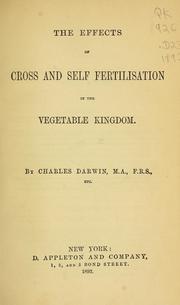 The effects of cross and self fertilisation in the vegetable kingdomCharles Darwin · 1876
 HothouseBrian W. Aldiss, Brian W. Aldiss · 1962
Ranked by number of editions on Open Library, a rough measure of how lasting a book is.
🔗 Related topics
- Sporophyte A sporophyte (/ˈspɔːr.əˌfaɪt/) is one of the two alternating multicellular phases in the life cycles of plants and algae. It is a diploid multicellular…
- Embryophyte The embryophytes (/ˈɛmbriəˌfaɪts/) are plants of the clade Embryophyta (/ˌɛmbriˈɒfətə, -oʊˈfaɪtə/), also known as Plantae sensu strictissimo (/pˈlænteɪ…
- Fossil history of flowering plants The fossil history of flowering plants records the development of flowers and other distinctive structures of the angiosperms, now the dominant group of…
- Gametophyte A gametophyte (/ɡəˈmiːtəfaɪt/) is one of the two alternating multicellular phases in the life cycles of plants. It is a haploid multicellular organism…
- Timeline of plant evolution This article attempts to place key plant innovations in a geological context. It concerns itself only with novel adaptations and events that had a major…
- Polysporangiophyte Polysporangiophytes, also called polysporangiates or formally Polysporangiophyta, are plants in which the spore-bearing generation (sporophyte) has branching…
- Microsporangium A microsporangium (pl. microsporangia) is a sporangium that produces microspores that give rise to male gametophytes when they germinate. Microsporangia…
- Gymnosperm The gymnosperms (/ˈdʒɪmnəˌspɜːrmz, -noʊ-/ nə-spurmz, -noh-; from Ancient Greek γυμνός, gymnós 'naked' and σπέρμα, spérma 'seed', thus 'naked seed') are…