Live briefing
Everything about Physical coding sublayer
Networking protocol sublayer
The physical coding sublayer (PCS) is a networking protocol sublayer in the Fast Ethernet, Gigabit Ethernet, and 10 Gigabit Ethernet standards. It resides at the top of the physical layer (PHY), and provides an interface between the physical medium attachment (PMA) sublayer and the media-independent interface (MII). It is responsible for data encoding and decoding, scrambling and descrambling, alignment marker insertion and removal, block and symbol redistribution, and lane block synchronization and deskew. Wikipedia →
🧭 Start here: a 6-step reading path
- Read the overview: Physical coding sublayerA 5-minute orientation
- Pick up a classic book: Computer NetworksThe most-reprinted book on the subject
- Read the landmark paper: A Physical Coding Sublayer for 100GbE [Applications & Practice]Cited 8 times
- Go sideways: Ethernet physical layerA closely related topic
- Go sideways: 10 Gigabit EthernetA closely related topic
📖 Definitions
No dictionary entry for this exact phrase.
🗂️ The subject at a glance
🏆 Landmark papers (most cited)
A Physical Coding Sublayer for 100GbE [Applications & Practice]
A 0.18 μm CMOS transmit physical coding sublayer IC for 100G Ethernet
High speed and reliability gearbox for 100GE physical coding sublayer
Reed–Solomon Hard-Decision and Algebraic Soft-Decision Decoders Compliant With the Physical Coding Sublayer Specification of the IEEE 802.3bp Automotive Ethernet Standard
📚 Books worth reading
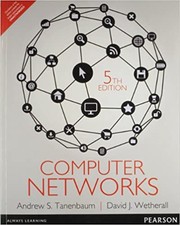 Computer NetworksAndrew S. Tanenbaum, John David Wetherall · 1981
Ranked by number of editions on Open Library, a rough measure of how lasting a book is.
🔗 Related topics
- Ethernet physical layer The physical-layer specifications of the Ethernet family of computer network standards are published by the Institute of Electrical and Electronics Engineers…
- 10 Gigabit Ethernet 10 Gigabit Ethernet (10GE, 10GbE, or 10 GigE) is a group of computer networking technologies for transmitting Ethernet frames at a rate of 10 gigabits…
- Physical medium dependent Physical medium dependent sublayers or PMDs further help to define the physical layer of computer network protocols. They define the details of transmission…
- XAUI 10 Gigabit Attachment Unit Interface (XAUI /ˈzaʊi/ ZOW-ee) is a standard for extending the XGMII (10 Gigabit Media Independent Interface) between the MAC…
- 2.5GBASE-T and 5GBASE-T IEEE 802.3bz, NBASE-T and MGBASE-T are standards released in 2016 for Ethernet over twisted pair at speeds of 2.5 and 5 Gbit/s. These use the same cabling…
- Gigabit Ethernet In computer networking, Gigabit Ethernet (GbE or 1 GigE) is the transmission of Ethernet frames at a rate of a gigabit per second. The most popular variant…
- Ethernet over twisted pair Ethernet over twisted-pair technologies use twisted-pair cables for the physical layer of an Ethernet computer network. They are a subset of all Ethernet…
- 25 Gigabit Ethernet 25 Gigabit Ethernet and 50 Gigabit Ethernet are standards for Ethernet connectivity in a datacenter environment, developed by IEEE 802.3 task forces 802…