Live briefing

Everything about Photodiode
Converts light into current
A photodiode is a semiconductor diode sensitive to photon radiation, such as visible light, infrared or ultraviolet radiation, X-rays and gamma rays. It produces an electrical current when it absorbs photons. This can be used for detection and measurement applications, or for the generation of electrical power in solar cells. Photodiodes are used in a wide range of applications throughout the electromagnetic spectrum from visible light photocells to gamma ray spectrometers. Wikipedia →
🧭 Start here: a 6-step reading path
- Read the overview: PhotodiodeA 5-minute orientation
- Skim a recent paper: High-speed flexible near-infrared organic photodiode for optical communicationInfluential work since 2022
- Pick up a classic book: Photodiode AmplifiersThe most-reprinted book on the subject
- Read the landmark paper: Comparative lipoquinone analysis of influent sewage and activated sludge by high-performance liquid chromatography and photodiode array detection.Cited 750 times
- Go sideways: PhotodetectorA closely related topic
- Go sideways: Active-pixel sensorA closely related topic
📖 Definitions
Noun A semiconductor two-terminal component whose electrical characteristics are light-sensitive.
🏆 Landmark papers (most cited)
Comparative lipoquinone analysis of influent sewage and activated sludge by high-performance liquid chromatography and photodiode array detection.
Coherent properties of a two-level system based on a quantum-dot photodiode
Simultaneous determination of catechins, caffeine and gallic acids in green, Oolong, black and pu-erh teas using HPLC with a photodiode array detector
A Review of the Pinned Photodiode for CCD and CMOS Image Sensors
Ultraviolet-enhanced photodiode employing n-ZnO/p-Si structure
Ultra-fast germanium photodiode with 3-dB bandwidth of 265 GHz
Direct detection of circular polarized light in helical 1D perovskite-based photodiode
A Molecular Photodiode System That Can Switch Photocurrent Direction
🆕 Influential since 2022
High-speed flexible near-infrared organic photodiode for optical communication
Flexible and broadband colloidal quantum dots photodiode array for pixel-level X-ray to near-infrared image fusion
Nonlinear germanium-silicon photodiode for activation and monitoring in photonic neuromorphic networks
High-performance modified uni-traveling carrier photodiode integrated on a thin-film lithium niobate platform
Avalanche photodiode with ultrahigh gain–bandwidth product of 1,033 GHz
📚 Books worth reading
 Photodiode AmplifiersJerald G. Graeme · 1995
 Broadband opto-electrical receivers in standard CMOSCarolien Hermans · 2007
 High-speed photodiodes in standard CMOS technologySasa Radovanovic, Anne-Johan Annema · 2006
- 📕"Receiver design, performance analysis, and evaluation for space-borne laser altimeters and space-to-space laser ranging systems"Frederic M. Davidson · 1994
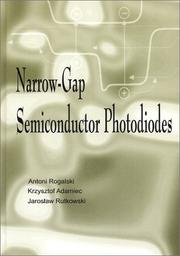 Narrow-gap semiconductor photodiodesAntoni Rogalski, Krzysztof Adamiec · 2000
- 📕Optical techniques for determination of normal shock position in supersonic flows for aerospace applicationsGrigory Adamovsky · 1990
 Design, characterization and simulation of avalanche photodiodesHektor Meier · 2011
 Sende- und Empfangsdioden für die Optische NachrichtentechnikWolfgang Harth, Helmut Grothe · 1998
Ranked by number of editions on Open Library, a rough measure of how lasting a book is.
🔗 Related topics
- Photodetector Photodetectors, also called photosensors, are devices that detect light or other forms of electromagnetic radiation and convert it into an electrical signal…
- Active-pixel sensor An active-pixel sensor (APS) is an image sensor where each pixel sensor unit cell has a photodetector (typically a pinned photodiode) and one or more active…
- Image sensor An image sensor or imager is a sensor used for imaging. It converts light into electrical signals, small bursts of current in proportion to the light intensity…
- Charge-coupled device A charge-coupled device (CCD) is an integrated circuit containing an array of linked, or coupled, capacitors. Under the control of an external circuit…
- Single-photon avalanche diode A single-photon avalanche diode (SPAD), also called Geiger-mode avalanche photodiode (G-APD or GM-APD) is a solid-state photodetector within the same family…
- Hole accumulation diode Hole accumulation diode (HAD) is an electronic noise reduction device in a charge-coupled device (CCD) or CMOS imaging sensor, patented by the Sony Corporation…
- Eric Fossum Eric R. Fossum (born October 17, 1957) is an American engineer. Currently, he is a professor at Thayer School of Engineering in Dartmouth College. Fossum…
- Electronic component An electronic component is any basic discrete electronic device or physical entity part of an electronic system used to affect electrons or their associated…