Live briefing
Everything about Phase rule
General principle in thermodynamics regarding pVT systems in equilibrium
In thermodynamics, the phase rule is a general principle governing multi-component, multi-phase systems in thermodynamic equilibrium. For a system without chemical reactions, it relates the number of freely varying intensive properties to the number of components, the number of phases, and number of ways of performing work on the system : Wikipedia →
🧭 Start here: a 6-step reading path
- Read the overview: Phase ruleA 5-minute orientation
- Skim a recent paper: LncRNAs divide and rule: The master regulators of phase separationInfluential work since 2022
- Pick up a classic book: The phase rule and its applicationsThe most-reprinted book on the subject
- Read the landmark paper: Solid‐Solution Phase Formation Rules for Multi‐component AlloysCited 3,473 times
- Go sideways: Phase diagramA closely related topic
- Go sideways: Vapor–liquid equilibriumA closely related topic
📖 Definitions
Noun the rule which states that the number of degrees of freedom in a system at equilibrium equals the number of components minus the number of phases plus 2
🗂️ The subject at a glance
🏆 Landmark papers (most cited)
Solid‐Solution Phase Formation Rules for Multi‐component Alloys
Unifying hydrotropy under Gibbs phase rule
Crystallography and the phase rule
Phase rule for capillary systems
Gibbs phase rule: A centenary retrospect
On Gibbs' phase rule
Phase Rule Studies of Soap Systems. I. Applicability of the Phase Rule
On Gibbs' phase rule
🆕 Influential since 2022
LncRNAs divide and rule: The master regulators of phase separation
Acceleration of phase diagram construction by machine learning incorporating Gibbs' phase rule
Phase selection rule of high‐entropy metallic glasses with different short‐to‐medium‐range orders
AI‐PAL: Self‐Supervised AI Phase Picking via Rule‐Based Algorithm for Generalized Earthquake Detection
Balanced Energy Gaps as a Key Design Rule for Solution‐Phase Organic Room Temperature Phosphorescence
📚 Books worth reading
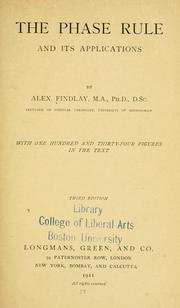 The phase rule and its applicationsAlexander Findlay · 1904
 HandbookPierre Villars, Karin Cenzual · 2011
 Phase transformations in metals and alloysDavid A. Porter, Kenneth E. Easterling · 1981
- 📕The phase rule and its applicationsAlexander Findlay · 1904
- 📕Phase diagrams for ceramistsErnest M. Levin · 1956
- 📕Phase Equilibria, Phase Diagrams and Phase TransformationsMats Hillert · 2007
- 📕Phase Behavior of Petroleum Reservoir FluidsKaren Schou Pedersen, Peter Lindskou Christensen · 2010
 Standard pressure-volume-temperature data for polymersPaul Zoller · 1995
Ranked by number of editions on Open Library, a rough measure of how lasting a book is.
🔗 Related topics
- Phase diagram A phase diagram in physical chemistry, engineering, mineralogy, and materials science is a type of chart used to show conditions (pressure, temperature…
- Vapor–liquid equilibrium In thermodynamics and chemical engineering, the vapor–liquid equilibrium (VLE) describes the distribution of chemical species between the vapor phase and…
- Vapor pressure Vapor pressure or equilibrium vapor pressure is the pressure exerted by a vapor in thermodynamic equilibrium with its condensed phases (solid or liquid)…
- Vapor In physics, a vapor (American English) or vapour (Commonwealth English; see spelling differences) is a substance in the gas phase at a temperature lower…
- Phase (matter) In the physical sciences, a phase is a region of material that is chemically uniform, physically distinct, and (often) mechanically separable. In a system…
- Triple point In thermodynamics, the triple point of a substance is the temperature and pressure at which the three phases (gas, liquid, and solid) of that substance…
- Raoult's law Raoult's law (/ˈrɑːuːlz/ law) is a relation of physical chemistry, with implications in thermodynamics. Proposed by French chemist François-Marie Raoult…
- Distillation Distillation, also classical distillation, is the process of separating the component substances of a liquid mixture of two or more chemically discrete…