Everything about Partition function (mathematics)
Generalization of the concept from statistical mechanics
The partition function or configuration integral, as used in probability theory, information theory and dynamical systems, is a generalization of the definition of a partition function in statistical mechanics. It is a special case of a normalizing constant in probability theory, for the Boltzmann distribution. The partition function occurs in many problems of probability theory because, in situations where there is a natural symmetry, its associated probability measure, the Gibbs measure, has the Markov property. This means that the partition function occurs not only in physical systems with translation symmetry, but also in such varied settings as neural networks, and applications such as genomics, corpus linguistics and artificial intelligence, which employ Markov networks, and Markov logic networks. The Gibbs measure is also the unique measure that has the property of maximizing the entropy for a fixed expectation value of the energy; this underlies the appearance of the partition function in maximum entropy methods and the algorithms derived therefrom. Wikipedia →
🧭 Start here: a 6-step reading path
- Read the overview: Partition function (mathematics)A 5-minute orientation
- Pick up a classic book: Über Modulfunktionen und PartitionenproblemeThe most-reprinted book on the subject
- Read the landmark paper: A paradox in the electronic partition function or how to be cautious with mathematicsCited 3 times
- Go sideways: Bernoulli schemeA closely related topic
- Go sideways: Mutual informationA closely related topic
📖 Definitions
No dictionary entry for this exact phrase.
🏆 Landmark papers (most cited)
📚 Books worth reading
- 📕Über Modulfunktionen und PartitionenproblemeHans Petersson · 1954
 Ramanujan's forty identities for the Rogers-Ramanujan functionsBruce C. Berndt, Geumlan Choi · 2007
- 📕A partition function with the prime modulus P>3John Livingood · 1945
 Partitions, q-Series, and Modular FormsKrishnaswami Alladi · 2012
- 📕Structures of subpartitions related to a submodular function minimizationTakeshi Naitoh, Akira Nakayama · 1995
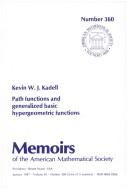 Path functions and generalized basic hypergeometric functionsKevin W. J. Kadell · 1987
 Analytic and combinatorial generalizations of the Rogers-Ramanujan identitiesDavid M. Bressoud · 1980
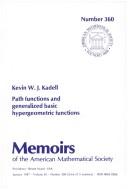 Path functions and generalized basic hypergeometric functionsKevin W. J. Kadell · 1987
Ranked by number of editions on Open Library, a rough measure of how lasting a book is.
🔗 Related topics
- Bernoulli scheme In mathematics, the Bernoulli scheme or Bernoulli shift is a generalization of the Bernoulli process to more than two possible outcomes. Bernoulli schemes…
- Mutual information In probability theory and information theory, the mutual information (MI) of two random variables is a measure of the mutual dependence between the two…
- Disintegration theorem In mathematics, the disintegration theorem is a result in measure theory and probability theory. It rigorously defines the idea of a non-trivial "restriction"…
- Asymptotic equipartition property In information theory, the asymptotic equipartition property (AEP) is a general property of the output samples of a stochastic source. It is fundamental…
- Conditional expectation In probability theory, the conditional expectation, conditional expected value, or conditional mean of a random variable is its expected value evaluated…
- Dirichlet distribution In probability and statistics, the Dirichlet distribution (after Peter Gustav Lejeune Dirichlet), often denoted Dir(𝜶), is a family of continuous multivariate…
- Law of large numbers In probability theory, the law of large numbers is a mathematical law which states that the average of the results obtained from a large number of independent…
- Joint entropy In information theory, joint entropy is a measure of the uncertainty associated with a set of variables. The joint Shannon entropy (in bits) of two discrete…