Live briefing
Everything about Oversampling
Sampling higher than the Nyquist rate
In signal processing, oversampling is the process of sampling a signal at a sampling frequency significantly higher than the Nyquist rate. Theoretically, a bandwidth-limited signal can be perfectly reconstructed if sampled at the Nyquist rate or above it. The Nyquist rate is defined as twice the bandwidth of the signal. Oversampling is capable of improving resolution and signal-to-noise ratio, and can be helpful in avoiding aliasing and phase distortion by relaxing anti-aliasing filter performance requirements. Wikipedia →
🧭 Start here: a 6-step reading path
- Read the overview: OversamplingA 5-minute orientation
- Skim a recent paper: Data oversampling and imbalanced datasets: an investigation of performance for machine learning and feature engineeringInfluential work since 2022
- Pick up a classic book: Neural Information ProcessingThe most-reprinted book on the subject
- Read the landmark paper: Improving imbalanced learning through a heuristic oversampling method based on k-means and SMOTECited 1,151 times
- Go sideways: Analog-to-digital converterA closely related topic
- Go sideways: Delta-sigma modulationA closely related topic
📖 Definitions
Verb present participle and gerund of oversample
Noun The act of one who oversamples.
🗂️ The subject at a glance
🏆 Landmark papers (most cited)
Improving imbalanced learning through a heuristic oversampling method based on k-means and SMOTE
MWMOTE--Majority Weighted Minority Oversampling Technique for Imbalanced Data Set Learning
A Comprehensive Analysis of Synthetic Minority Oversampling Technique (SMOTE) for handling class imbalance
SMOTE-RSB *: a hybrid preprocessing approach based on oversampling and undersampling for high imbalanced data-sets using SMOTE and rough sets theory
A theoretical distribution analysis of synthetic minority oversampling technique (SMOTE) for imbalanced learning
A Comparison of Undersampling, Oversampling, and SMOTE Methods for Dealing with Imbalanced Classification in Educational Data Mining
Machine learning-based network intrusion detection for big and imbalanced data using oversampling, stacking feature embedding and feature extraction
Rapid gridding reconstruction with a minimal oversampling ratio
🆕 Influential since 2022
Data oversampling and imbalanced datasets: an investigation of performance for machine learning and feature engineering
FW-SMOTE: A feature-weighted oversampling approach for imbalanced classification
Stop Oversampling for Class Imbalance Learning: A Review
Rolling Bearing Fault Diagnosis Under Data Imbalance and Variable Speed Based on Adaptive Clustering Weighted Oversampling
Challenges and limitations of synthetic minority oversampling techniques in machine learning
📚 Books worth reading
 Neural Information ProcessingTingwen Huang · 2012
 Medicaid quality controlUnited States. Medicaid Bureau. Division of Quality Control · 1978
 Oversampling A/D converters with improved signal transfer functionsBupesh Pandita · 2011
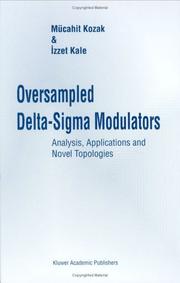 Oversampled delta-sigma modulatorsMücahit Kozak · 2003
- 📕Design of Modulators for Oversampled ConvertersFeng Wang, Ramesh Harjani · 1997
 Analog integrated circuit designTony Chan Carusone · 2011
- 📕Oversampling digital-to-analog convertersShaofeng Shu · 1995
 Oversampling delta-sigma data convertersGabor C. Temes · 1991
Ranked by number of editions on Open Library, a rough measure of how lasting a book is.
🔗 Related topics
- Analog-to-digital converter In electronics, an analog-to-digital converter (ADC, A/D, or A-to-D) is a system that converts an analog signal, such as from fingers touching a touchscreen…
- Delta-sigma modulation Delta–sigma (ΔΣ; or sigma–delta, ΣΔ) modulation is an oversampling method for encoding signals into low bit depth digital signals at a very high sample-frequenc…
- Anti-aliasing filter An anti-aliasing filter (AAF) is a filter used before a signal sampler to restrict the bandwidth of a signal to satisfy the Nyquist–Shannon sampling theorem…
- Audio bit depth In digital audio using pulse-code modulation (PCM), bit depth is the number of bits of information in each sample, and it directly corresponds to the resolution…
- Sampling (signal processing) In signal processing, sampling is the reduction of a continuous-time signal to a discrete-time signal. A common example is the conversion of a sound wave…
- Digital-to-analog converter In electronics, a digital-to-analog converter (DAC, D/A, D2A, or D-to-A) is a system that converts a digital signal into an analog signal. An analog-to-digital…
- Time-interleaved ADC Time interleaved (TI) ADCs are analog-to-digital converters (ADCs) that involve multiple converters working in parallel. Each of the converters is referred…
- 1-bit DAC A 1-bit DAC (sometimes called Bitstream converter by Philips) is a consumer electronics marketing term describing an oversampling digital-to-analog converter…