Live briefing

Everything about Bipartite graph
Graph divided into two independent sets
In the mathematical field of graph theory, a bipartite graph is a graph whose vertices can be divided into two disjoint and independent sets and, that is, every edge connects a vertex in to one in. Vertex sets and are usually called the parts of the graph. Equivalently, a bipartite graph is a graph that does not contain any odd-length cycles. Wikipedia →
🧭 Start here: a 6-step reading path
- Read the overview: Bipartite graphA 5-minute orientation
- Skim a recent paper: The Odd Chromatic Number of a Planar Graph is at Most 8Influential work since 2022
- Pick up a classic book: Calculus, Early TranscendentalsThe most-reprinted book on the subject
- Read the landmark paper: Wiener Index Extension by Counting Even/Odd Graph DistancesCited 49 times
- Go sideways: Glossary of graph theoryA closely related topic
- Go sideways: Kőnig's theorem (graph theory)A closely related topic
📖 Definitions
No dictionary entry for this exact phrase.
🗂️ The subject at a glance
🏆 Landmark papers (most cited)
Wiener Index Extension by Counting Even/Odd Graph Distances
SOME ODD GRAPH THEORY
More odd graph theory
The Odd-Distance Plane Graph
A Note on Odd Cycle-Complete Graph Ramsey Numbers
Odd mean labeling for two star graph
Covering the edges of a graph by three odd subgraphs
On weak odd domination and graph-based quantum secret sharing
🆕 Influential since 2022
The Odd Chromatic Number of a Planar Graph is at Most 8
The odd chromatic number of a toroidal graph is at most 9
Every graph contains a linearly sized induced subgraph with all degrees odd
Disjoint odd circuits in a bridgeless cubic graph can be quelled by a single perfect matching
Turán problem of signed graph for negative odd cycle
📚 Books worth reading
 Calculus, Early TranscendentalsJames Stewart · 1991
 Single Variable Calculus, Early TranscendentalsJames Stewart · 1991
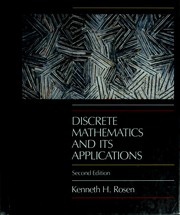 Discrete Mathematics and Its ApplicationsKenneth H. Rosen · 1988
 Mathematical structures for computer scienceJudith L. Gersting · 1982
 StatisticsJoseph F. Healey · 1990
 Elementary & intermediate algebraJay Lehmann · 2010
 Elementary StatisticsRon Larson, Betsy Farber · 2003
 Math on callGreat Source Education Group · 1998
Ranked by number of editions on Open Library, a rough measure of how lasting a book is.
🔗 Related topics
- Glossary of graph theory Look up Appendix:Glossary of graph theory in Wiktionary, the free dictionary. This is a glossary of graph theory. Graph theory is the study of graphs,…
- Kőnig's theorem (graph theory) In the mathematical area of graph theory, Kőnig's theorem, proved by Dénes Kőnig (1931), describes an equivalence between the maximum matching problem…
- Balanced hypergraph In graph theory, a balanced hypergraph is a hypergraph that has several properties analogous to that of a bipartite graph. Balanced hypergraphs were introduced…
- Matching (graph theory) In the mathematical discipline of graph theory, a matching or independent edge set in an undirected graph is a set of edges without common vertices. In…
- Perfect graph In graph theory, a perfect graph is a graph in which the chromatic number equals the size of the maximum clique, both in the graph itself and in every…
- Perfect graph theorem In graph theory, the perfect graph theorem of László Lovász (1972a, 1972b) states that an undirected graph is perfect if and only if its complement graph…
- Matching in hypergraphs In graph theory, a matching in a hypergraph is a set of hyperedges, in which every two hyperedges are disjoint. It is an extension of the notion of matching…
- Fractional matching In graph theory, a fractional matching is a generalization of a matching in which, intuitively, each vertex may be broken into fractions that are matched…