Everything about Nonexistent objects
Philosophical treatment of oxymorons
In metaphysics and ontology, nonexistent objects are a concept advanced by Austrian philosopher Alexius Meinong in the 19th and 20th centuries within a "theory of objects". He was interested in intentional states which are directed at nonexistent objects. Starting with the "principle of intentionality", mental phenomena are intentionally directed towards an object. People may imagine, desire or fear something that does not exist. Other philosophers concluded that intentionality is not a real relation and therefore does not require the existence of an object, while Meinong concluded there is an object for every mental state whatsoever—if not an existent then at least a nonexistent one. Wikipedia →
🧭 Start here: a 6-step reading path
- Read the overview: Nonexistent objectsA 5-minute orientation
- Skim a recent paper: Nonexistent Objects: The Avicenna TransformInfluential work since 2022
- Pick up a classic book: Eliminativism Objects and PersonsThe most-reprinted book on the subject
- Read the landmark paper: Referring to nonexistent objectsCited 16 times
- Go sideways: Abstract object theoryA closely related topic
- Go sideways: Ernst MallyA closely related topic
📖 Definitions
No dictionary entry for this exact phrase.
🗂️ The subject at a glance
🏆 Landmark papers (most cited)
Referring to nonexistent objects
An alternative theory of nonexistent objects
Cognitive flexibility in children with Developmental Language Disorder: Drawing of nonexistent objects
Thinking About Different Nonexistents of the Same Kind: Reid's Account of the Imagination and its Nonexistent Objects
Nonexistent Objects as Truth-Makers: Against Crane’s Reductionism
Are there nonexistent objects? Why not? But where are they?
Nonexistent Objects.
The Importance of Nonexistent Objects and of Intensionality in Mathematics†
🆕 Influential since 2022
📚 Books worth reading
- 📕Eliminativism Objects and PersonsJiri Benovsky · 2018
 Objects of ThoughtTim Crane · 2013
- 📕Objects and Pseudo-ObjectsBruno Leclercq, Sebastien Richard · 2015
 God, Existence, and Fictional ObjectsJohn-Mark L. Miravalle · 2018
- 📕NonexistentAnthony Everett · 2013
 Meinong's theory of objects and valuesFindlay, J. N., Findlay · 1963
- 📕Nonexistent Objects in Buddhist PhilosophyZhihua Yao · 2020
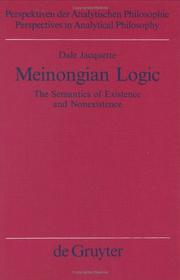 Meinongian logicDale Jacquette · 1996
Ranked by number of editions on Open Library, a rough measure of how lasting a book is.
🔗 Related topics
- Abstract object theory Abstract object theory (AOT) is a branch of metaphysics regarding abstract objects. Originally devised by metaphysician Edward Zalta in 1981, the theory…
- Ernst Mally Ernst Mally (/ˈmɑːli/; German: [ˈmali]; 11 October 1879 – 8 March 1944) was an Austrian analytic philosopher, initially affiliated with Alexius Meinong's…
- Noneism Noneism, also known as modal Meinongianism (named after Alexius Meinong), is a theory in logic and metaphysics. It holds that some things do not exist…
- Alexius Meinong Alexius Meinong von Handschuchsheim (German: [ˈmaɪnɔŋ]; 17 July 1853 – 27 November 1920) was an Austrian philosopher, a realist known for his unique ontology…
- Existence Existence is the state of having being or reality in contrast to nonexistence and nonbeing. Existence is often contrasted with essence: the essence of…
- William J. Rapaport William Joseph Rapaport is an American philosopher who is an associate professor emeritus of the University at Buffalo. Rapaport has done research and…
- Edward N. Zalta Edward Nouri Zalta (/ˈzɔːltə/; born March 16, 1952) is an American philosopher who is a senior research scholar at the Center for the Study of Language…
- Meinongian argument The Meinongian argument is a type of ontological argument or an "a priori argument" that seeks to prove the existence of God. This is through an assertion…