Live briefing
Everything about Namespace
Container for a set of identifiers
In computing, a namespace is a set of signs (names) that are used to identify and refer to objects of various kinds. A namespace ensures that all of a given set of objects have unique names so that they can be easily identified. Wikipedia →
🧭 Start here: a 6-step reading path
- Read the overview: NamespaceA 5-minute orientation
- Skim a recent paper: Preemptive Zone Reset Design within Zoned Namespace SSD FirmwareInfluential work since 2022
- Pick up a classic book: Fundamentals of Computer Programming with CSharp Free Book (by Nakov & Co.)The most-reprinted book on the subject
- Read the landmark paper: gprofiler2 -- an R package for gene list functional enrichment analysis and namespace conversion toolset g:ProfilerCited 940 times
- Go sideways: Java syntaxA closely related topic
- Go sideways: Type introspectionA closely related topic
📖 Definitions
Noun A conceptual space that groups classes, identifiers, etc. in order to avoid conflicts with items in unrelated code that carry the same names.
Verb To categorize by placing into a namespace.
🗂️ The subject at a glance
🏆 Landmark papers (most cited)
gprofiler2 -- an R package for gene list functional enrichment analysis and namespace conversion toolset g:Profiler
gprofiler2 -- an R package for gene list functional enrichment analysis and namespace conversion toolset g:Profiler
MetaNetX/MNXref: unified namespace for metabolites and biochemical reactions in the context of metabolic models
SplitZNS: Towards an Efficient LSM-Tree on Zoned Namespace SSDs
Versatility and Unix semantics in namespace unification
OPC UA and MQTT performance analysis within a unified namespace context
A Hierarchical Namespace Approach for Multi-Tenancy in Distributed Clouds
eZNS: Elastic Zoned Namespace for Enhanced Performance Isolation and Device Utilization
🆕 Influential since 2022
Preemptive Zone Reset Design within Zoned Namespace SSD Firmware
Exploiting Flat Namespace to Improve File System Metadata Performance on Ultra-Fast, Byte-Addressable NVMs
Land of Oz: Resolving Orderless Writes in Zoned Namespace SSDs
exZNS: Extending Zoned Namespace to Support Byte-loggable Zones
Unified Namespace: A New Paradigm for Industrial IoT Data Integration
📚 Books worth reading
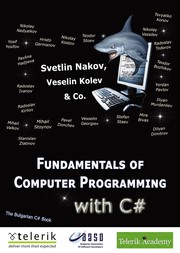 Fundamentals of Computer Programming with CSharp Free Book (by Nakov & Co.)Svetlin Nakov · 2013
Ranked by number of editions on Open Library, a rough measure of how lasting a book is.
🔗 Related topics
- Java syntax The syntax of Java is the set of rules defining how a Java program is written and interpreted. The syntax is mostly derived from C and C++. Unlike C++…
- Type introspection In computing, type introspection is the ability of a program to examine the type or properties of an object at runtime. Some programming languages possess…
- Dependency injection In software engineering, dependency injection is a programming technique in which an object or function receives other objects or functions that it requires…
- Template (C++) Templates are a feature of the C++ programming language that allow functions and classes to operate with generic types. This allows a function or class…
- Bridge pattern The bridge pattern is a design pattern used in software engineering that is meant to "decouple an abstraction from its implementation so that the two can…
- Concepts (C++) Concepts in the C++ programming language are type constraints on templates (or generics). Concepts are named Boolean predicates on template parameters…
- Destructor (computer programming) In object-oriented programming, a destructor (sometimes abbreviated dtor) is a method which is invoked mechanically just before the memory of the object…
- Include directive An include directive instructs a text file processor to replace the directive text with the content of a specified file. The act of including may be logical…