Everything about Mycin
Expert system for bacterial infections
MYCIN was an early backward chaining expert system that used black box to identify bacteria causing severe infections, such as bacteremia and meningitis, and to recommend antibiotics, with the dosage adjusted for patient's body weight — the name derived from the antibiotics themselves, as many antibiotics have the suffix "-mycin". The Mycin system was also used for the diagnosis of blood clotting diseases. MYCIN was developed over five or six years in the early 1970s at Stanford University. It was written in Lisp as the doctoral dissertation of Edward Shortliffe under the direction of Bruce G. Buchanan, Stanley N. Cohen and others. Wikipedia →
🧭 Start here: a 6-step reading path
- Read the overview: MycinA 5-minute orientation
- Skim a recent paper: From MYCIN to MedGemma: A Historical and Comparative Analysis of Healthcare AI EvolutionInfluential work since 2022
- Pick up a classic book: Rule-based expert systemsThe most-reprinted book on the subject
- Read the landmark paper: Computer-based consultations in clinical therapeutics: Explanation and rule acquisition capabilities of the MYCIN systemCited 399 times
- Go sideways: Edward H. ShortliffeA closely related topic
- Go sideways: Knowledge engineeringA closely related topic
📖 Definitions
Noun Any -mycin compound.
🗂️ The subject at a glance
🏆 Landmark papers (most cited)
Computer-based consultations in clinical therapeutics: Explanation and rule acquisition capabilities of the MYCIN system
MYCIN: a knowledge-based consultation program for infectious disease diagnosis
Van Melle's combining function in MYCIN is a representable uninorm: An alternative proof
The MYCIN certainty factor handling function as uninorm operator and its use as a threshold function in artificial neurons
Colistin(Coly-Mycin) in Resistant Bacterial Infections
CADIAG-2 and MYCIN-like systems
Rule-based expert systems: The mycin experiments of the stanford heuristic programming project
An unusual case of neuromuscular blockade seen with therapeutic blood levels of colistin methanesulfonate (Coly-Mycin)
🆕 Influential since 2022
📚 Books worth reading
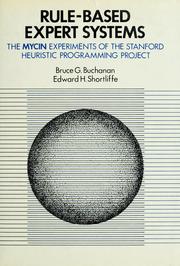 Rule-based expert systemsBruce G. Buchanan, Edward Hance Shortliffe · 1984
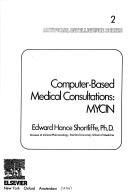 Computer-based medical consultations, MYCINEdward Hance Shortliffe · 1976
 Knowledge-based tutoringWilliam J. Clancey · 1987
 Systèmes expertsJ. L. Alty · 1986
Ranked by number of editions on Open Library, a rough measure of how lasting a book is.
🔗 Related topics
- Edward H. Shortliffe Edward ("Ted") Hance Shortliffe (born 1947) is a Canadian-born American biomedical informatician, physician, and computer scientist. Shortliffe is a pioneer…
- Knowledge engineering Knowledge engineering (KE) refers to all aspects involved in knowledge-based systems. One of the first examples of an expert system was MYCIN, an application…
- Dendral Dendral was a project in artificial intelligence (AI) of the 1960s, and the computer software expert system that it produced. Its primary aim was to study…
- Expert system In artificial intelligence (AI), an expert system is a computer system emulating the decision-making ability of a human expert. Expert systems are designed…
- CADUCEUS (expert system) CADUCEUS was a medical expert system, an early type of recommender system - by Harry Pople of the University of Pittsburgh. Finished in the mid-1980s,…
- Symbolic artificial intelligence In artificial intelligence (AI), symbolic artificial intelligence (also known as classical artificial intelligence or logic-based artificial intelligence)…
- Model-based reasoning In artificial intelligence, model-based reasoning refers to an inference method used in expert systems based on a model of the physical world. With this…
- Douglas Lenat Douglas Bruce Lenat (September 13, 1950 – August 31, 2023) was an American computer scientist and researcher in artificial intelligence who was the founder…