Live briefing
Everything about Multiple correspondence analysis
Data analysis technique
In statistics, multiple correspondence analysis (MCA) is a data analysis technique for nominal categorical data, used to detect and represent underlying structures in a data set. It does this by representing data as points in a low-dimensional Euclidean space. The procedure thus appears to be the counterpart of principal component analysis for categorical data. MCA can be viewed as an extension of simple correspondence analysis (CA) in that it is applicable to a large set of categorical variables. Wikipedia →
🧭 Start here: a 6-step reading path
- Read the overview: Multiple correspondence analysisA 5-minute orientation
- Skim a recent paper: Analysis and assessment of ship collision accidents using Fault Tree and Multiple Correspondence AnalysisInfluential work since 2022
- Pick up a classic book: Bourdieu and Data AnalysisThe most-reprinted book on the subject
- Read the landmark paper: Multiple Multinational Tourism Positioning Using Correspondence AnalysisCited 168 times
- Go sideways: Factor analysis of mixed dataA closely related topic
- Go sideways: Total least squaresA closely related topic
📖 Definitions
No dictionary entry for this exact phrase.
🏆 Landmark papers (most cited)
Multiple Multinational Tourism Positioning Using Correspondence Analysis
Multiple correspondence analysis: one only or several techniques?
Interpreting multiple correspondence analysis as a multidimensional scaling method
Handling Missing Values with Regularized Iterative Multiple Correspondence Analysis
Factor Association with Multiple Correspondence Analysis in Vehicle–Pedestrian Crashes
Dimensions of cultural consumption among tourists: Multiple correspondence analysis
Interpreting multiple correspondence analysis
MIMCA: multiple imputation for categorical variables with multiple correspondence analysis
🆕 Influential since 2022
Analysis and assessment of ship collision accidents using Fault Tree and Multiple Correspondence Analysis
Charting fields and spaces quantitatively: from multiple correspondence analysis to categorical principal components analysis
Temporal stability of associations between crash characteristics: A multiple correspondence analysis
“Automatic” interpretation of multiple correspondence analysis (MCA) results for nonexpert users, using R programming
Analysis of clustering algorithms for credit risk evaluation using multiple correspondence analysis
📚 Books worth reading
 Bourdieu and Data AnalysisFrédéric Lebaron, Michael Grenfell · 2014
- 📕Multiple correspondence analysisBrigitte Le Roux · 2009
 Multiple correspondence analysis · 2010
- 📕Multiple correspondence analysisBrigitte Le Roux · 2010
 Multiple correspondence analysis and related methods · 2006
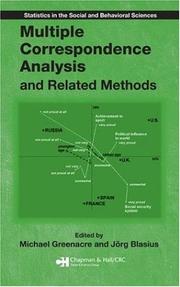 Multiple correspondence analysis and related methodsMichael J. Greenacre, Jörg Blasius · 2006
 Visualization and verbalization of dataJorg Blasius, Michael J. Greenacre · 2014
Ranked by number of editions on Open Library, a rough measure of how lasting a book is.
🔗 Related topics
- Factor analysis of mixed data In statistics, factor analysis of mixed data or factorial analysis of mixed data (FAMD, in the French original: AFDM or Analyse Factorielle de Données…
- Total least squares In applied statistics, total least squares is a type of errors-in-variables regression, a least squares data modeling technique in which observational…
- Iterative proportional fitting The iterative proportional fitting procedure (IPF or IPFP, also known as biproportional fitting or biproportion in statistics or economics (input-output…
- Vector generalized linear model In statistics, the class of vector generalized linear models (VGLMs) was proposed to enlarge the scope of models catered for by generalized linear models…
- Correspondence analysis Correspondence analysis (CA) is a multivariate statistical technique proposed by Herman Otto Hartley (Hirschfeld) and later developed by Jean-Paul Benzécri…
- Principal component regression In statistics, principal component regression (PCR) is a regression analysis technique that is based on principal component analysis (PCA). PCR is a form…
- Dilution of precision Dilution of precision (DOP), or geometric dilution of precision (GDOP), is a term used in satellite navigation and geomatics engineering to specify the…
- Symmetric matrix In linear algebra, a symmetric matrix is a square matrix that is equal to its transpose. Formally, A is symmetric ⟺ A = A T . {\displaystyle A{\text{…