Everything about Monopoly
Market structure with a single firm dominating the market
A monopoly is a market in which one person or company is the only supplier of a particular good or service. A monopoly is characterized by a lack of economic competition to produce a particular thing, a lack of viable substitute goods, and the possibility of a high monopoly price well above the seller's marginal cost that leads to a high monopoly profit. The verb monopolise or monopolize refers to the process by which a company gains the ability to raise prices or exclude competitors. In economics, a monopoly is a single seller. In law, a monopoly is a business entity that has significant market power, that is, the power to charge overly high prices, which is associated with unfair price raises. Although monopolies may be big businesses, size is not a characteristic of a monopoly. A small business may still have the power to raise prices in a small industry. Wikipedia →
🧭 Start here: a 6-step reading path
- Read the overview: MonopolyA 5-minute orientation
- Skim a recent paper: Becoming an intellectual monopoly by relying on the national innovation system: the State Grid Corporation of China's experienceInfluential work since 2022
- Pick up a classic book: Monopoly CapitalThe most-reprinted book on the subject
- Read the landmark paper: Labor and Monopoly CapitalCited 3,811 times
- Go sideways: Marginal revenueA closely related topic
- Go sideways: Monopoly priceA closely related topic
📖 Definitions
Noun A situation, by legal privilege or other agreement, in which solely one party (company, cartel etc.) exclusively provides a particular product or service, dominating that market and generally exerting powerful control over it.
Noun An exclusive control over the trade or production of a commodity or service through exclusive possession.
Noun The privilege granting the exclusive right to exert such control.
Noun The market thus controlled.
🏆 Landmark papers (most cited)
Labor and Monopoly Capital
Monopoly and product quality
Durability and Monopoly
Commodity Bundling and the Burden of Monopoly
The Concept of Monopoly and the Measurement of Monopoly Power
Monopoly with Incomplete Information
Testing For "Monopoly" Equilibrium
The Social Costs of Monopoly and Regulation
🆕 Influential since 2022
Becoming an intellectual monopoly by relying on the national innovation system: the State Grid Corporation of China's experience
Administrative monopoly and state-owned enterprise innovation: Evidence from the fair competition review system in China
Does administrative monopoly regulation affect corporate financialization? From the perspective of vertical industrial chain competition in China
The Roles of Anti-Monopoly on Green Innovation: Evidence from the Chinese Manufacturing Industry
Managing Multirooming: Why Uniform Price Can Be Optimal for a Monopoly Retailer and Can Be Uniformly Lower
📚 Books worth reading
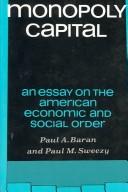 Monopoly CapitalPaul A. Baran, Paul Marlor Sweezy · 1966
 Do not pass goMoore, Tim, Tim Moore · 1999
 Theories of the Bargaining ProcessAlan Coddington · 1968
 Monopolies and the peopleCharles Whiting Baker · 1889
- 📕Government Monopoly of Telephone Communication in D.CUnited States. Congress. House. Committee on the District of Columbia · 1971
 Monopolies and the peopleD. C. Cloud · 1873
 Monopolies and trustsRichard Theodore Ely · 1900
 The EveryDave Eggers · 2021
Ranked by number of editions on Open Library, a rough measure of how lasting a book is.
🔗 Related topics
- Marginal revenue Marginal revenue (or marginal benefit) is a central concept in microeconomics that describes the additional total revenue generated by increasing product…
- Monopoly price In microeconomics, a monopoly price is set by a monopoly. A monopoly occurs when a firm lacks any viable competition and is the sole producer of the industry's…
- Monopoly profit Monopoly profit is an inflated level of profit due to the monopolistic practices of an enterprise. Traditional economics state that in a competitive market…
- Monopolistic competition Monopolistic competition is a type of imperfect competition such that there are many producers competing against each other but selling products that are…
- Profit (economics) In economics, profit is the difference between revenue that an economic entity has received from its outputs and total costs of its inputs, also known…
- Profit maximization In economics, profit maximization is the short run or long run process by which a firm may determine the price, input and output levels that will lead…
- Imperfect competition In economics, imperfect competition refers to a situation where the characteristics of an economic market do not fulfill all the necessary conditions of…
- Perfect competition In economics, specifically general equilibrium theory, a perfect market, also known as an atomistic market, is defined by several idealizing conditions…