Everything about Meshfree methods
Methods in numerical analysis not requiring knowledge of neighboring points

In the field of numerical analysis, meshfree methods are those that do not require connection between nodes of the simulation domain, i.e. a mesh, but are rather based on interaction of each node with all its neighbors. As a consequence, original extensive properties such as mass or kinetic energy are no longer assigned to mesh elements but rather to the single nodes. Meshfree methods enable the simulation of some otherwise difficult types of problems, at the cost of extra computing time and programming effort. The absence of a mesh allows Lagrangian simulations, in which the nodes can move according to the velocity field. Wikipedia →
🧭 Start here: a 6-step reading path
- Read the overview: Meshfree methodsA 5-minute orientation
- Skim a recent paper: Point Cloud Generation for Meshfree Methods: An OverviewInfluential work since 2022
- Pick up a classic book: An introduction to meshfree methods and their programmingThe most-reprinted book on the subject
- Read the landmark paper: Meshfree and particle methods and their applicationsCited 711 times
- Go sideways: Smoothed finite element methodA closely related topic
- Go sideways: Weakened weak formA closely related topic
📖 Definitions
No dictionary entry for this exact phrase.
🗂️ The subject at a glance
🏆 Landmark papers (most cited)
Meshfree and particle methods and their applications
Meshfree and finite element nodal integration methods
Meshfree Methods: Progress Made after 20 Years
Extended meshfree methods without branch enrichment for cohesive cracks
On the completeness of meshfree particle methods
Modelling dynamic failure of concrete with meshfree methods
An Overview on Meshfree Methods: For Computational Solid Mechanics
Discontinuous modelling of shear bands using adaptive meshfree methods
🆕 Influential since 2022
Point Cloud Generation for Meshfree Methods: An Overview
An accuracy analysis framework for meshfree collocation methods with particular emphasis on boundary effects
A consistent projection integration for Galerkin meshfree methods
Meshfree Methods in Geohazards Prevention: A Survey
Meshfree methods for the variable-order fractional advection–diffusion equation
📚 Books worth reading
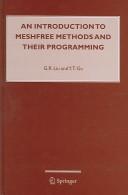 An introduction to meshfree methods and their programmingG. R. Liu · 1899
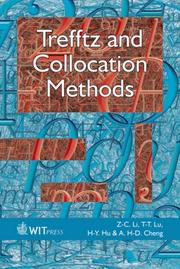 Trefftz And Collocation MethodsH. Cheng · 2008
 Progress on meshless methodsA. J. M. Ferreira · 2009
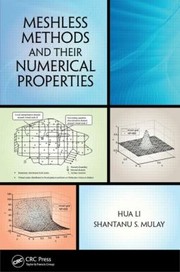 Meshless Methods And Their Numerical PropertiesHua Li · 2012
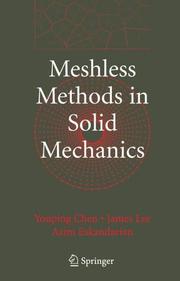 Meshless methods in solid mechanicsYouping Chen · 2006
 Smoothed particle hydrodynamicsG. R. Liu · 2003
 Meshfree particle methodsShaofan Li · 2004
 Advances in meshfree techniquesC. Armando Duarte · 2007
Ranked by number of editions on Open Library, a rough measure of how lasting a book is.
🔗 Related topics
- Smoothed finite element method Smoothed finite element methods (S-FEM) are a particular class of numerical simulation algorithms for the simulation of physical phenomena. It was developed…
- Weakened weak form Weakened weak form (or W2 form) is used in the formulation of general numerical methods based on meshfree methods and/or finite element method settings…
- Material point method The material point method (MPM) is a numerical technique used to simulate the behavior of solids, liquids, gases, and any other continuum material. Especially…
- Finite element method Finite element method (FEM) is a popular method for numerically solving differential equations arising in engineering and mathematical modeling. Typical…
- Kansa method The Kansa method (also known as the unsymmetric radial basis function collocation method) is a meshless numerical method for solving partial differential…
- Spectral element method In the numerical solution of partial differential equations, a topic in mathematics, the spectral element method (SEM) is a formulation of the finite element…
- Boundary knot method In numerical mathematics, the boundary knot method (BKM) is proposed as an alternative boundary-type meshfree distance function collocation scheme. Recent…
- Finite pointset method In applied mathematics, the finite pointset method (FPM) is a general approach for the numerical solution of problems in continuum mechanics, such as the…