Live briefing

Everything about Magnanimity
Virtue of being great of mind and heart
Magnanimity is the virtue of being great of mind and heart. It usually encompasses a refusal to be petty, a willingness to face danger, and actions for noble purposes. Its antithesis is pusillanimity. Although the word magnanimity has a traditional connection to Aristotelian philosophy, it also has its own tradition in English which now causes some confusion. Wikipedia →
🧭 Start here: a 6-step reading path
- Read the overview: MagnanimityA 5-minute orientation
- Skim a recent paper: Humility, Courage, Magnanimity: a Thomistic AccountInfluential work since 2022
- Pick up a classic book: Women and the GiftThe most-reprinted book on the subject
- Read the landmark paper: The evolution of magnanimityCited 133 times
- Go sideways: Nicomachean EthicsA closely related topic
- Go sideways: Magnificence (history of ideas)A closely related topic
📖 Definitions
Noun The quality of being magnanimous; kindness of nature; generosity.
🗂️ The subject at a glance
🏆 Landmark papers (most cited)
The evolution of magnanimity
Religious magnanimity: Reminding people of their religious belief system reduces hostility after threat.
Money and Magnanimity: New Findings on the Distribution of Income, Wealth, and Philanthropy
"Magnanimity" in Aristotle's Ethics
Magnanimity and Integrity as Military Virtues
Higher power dynamics: How meaning search and self-transcendence inspire approach motivation and magnanimity
Statesmanship as Magnanimity: Classical, Christian & Modern
Magnanimity, Mεγαλοψυχία, and the System of Aristotle’s Nicomachean Ethics
🆕 Influential since 2022
Humility, Courage, Magnanimity: a Thomistic Account
Thomas Aquinas: Magnanimity and the Humble Servant Leader in the Summa Theologica
John Milton, Oliver Cromwell, and virtue politics: magnanimity in England, Eden, and Hell
Tempering senses of superiority: The virtue of magnanimity in democracies
The Age of Magnanimity: Aristotle’s megalopsychia and Hegel’s die schöne Seele
📚 Books worth reading
 Women and the GiftMorny Joy · 2013
 Created for greatnessAlexandre Havard · 2011
- 📕De magnanimitateGiovanni Gioviano Pontano · 1969
- 📕Magnanimous HeartNarayan Helen Liebenson · 2019
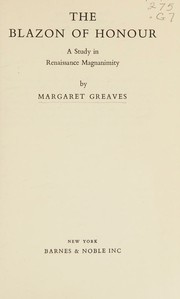 The blazon of honourMargaret Greaves · 1964
 The blazon of honourMargaret Greaves · 1964
 La dialettica magnanimita-prudenza in DanteMassimo Seriacopi · 2006
- 📕Measure of GreatnessSophia Vasalou · 2019
Ranked by number of editions on Open Library, a rough measure of how lasting a book is.
🔗 Related topics
- Nicomachean Ethics The Nicomachean Ethics (/ˌnaɪkɒməˈkiən, ˌnɪ-/; Ancient Greek: Ἠθικὰ Νικομάχεια, Ēthika Nikomacheia) is Aristotle's best-known work on ethics: the philosophical…
- Magnificence (history of ideas) The word magnificence comes from the Latin “magnum facere”, which means to do something great. The Latin word draws on the Greek “megaloprépeia”. This…
- Aristotelian ethics Aristotle first used the term ethics to name a field of study developed by his predecessors Socrates and Plato which is devoted to the attempt to provide…
- Eudemian Ethics The Eudemian Ethics (Greek: Ἠθικὰ Εὐδήμεια; Latin: Ethica Eudemia or De moribus ad Eudemum) is a work of philosophy by Aristotle. Its primary focus is…
- The Faerie Queene The Faerie Queene is an English epic poem by Edmund Spenser. Books I–III were first published in 1590, then republished in 1596 together with books IV–VI…
- Justice (virtue) Justice is one of the four cardinal virtues in classical European philosophy and Roman Catholicism. It is the moderation or mean between selfishness and…
- Kalos kagathos Kalos kagathos or kalokagathos (Ancient Greek: καλὸς κἀγαθός [kalòs kaːɡatʰós]), of which kalokagathia (καλοκαγαθία) is the derived noun, is a phrase used…
- Edmund Spenser Edmund Spenser (c. 1552 – 13 January 1599 O.S.) was an English poet who is best known for having written The Faerie Queene, an epic poem and fantastical…