Live briefing
Everything about Lexical semantics
Subfield of linguistic semantics
Lexical semantics, as a subfield of linguistic semantics, is the study of word meanings. It includes the study of how words structure their meaning, how they act in grammar and compositionality, and the relationships between the distinct senses and uses of a word. Wikipedia →
🧭 Start here: a 6-step reading path
- Read the overview: Lexical semanticsA 5-minute orientation
- Skim a recent paper: Lexico-semantics obscures lexical syntaxInfluential work since 2022
- Pick up a classic book: Lexical functional grammarThe most-reprinted book on the subject
- Read the landmark paper: Semantic priming and retrieval from lexical memory: Roles of inhibitionless spreading activation and limited-capacity attention.Cited 1,764 times
- Go sideways: Linguistics warsA closely related topic
- Go sideways: Labile verbA closely related topic
📖 Definitions
Noun The study of how the words of a language denote either things in the real world or concepts.
🏆 Landmark papers (most cited)
Semantic priming and retrieval from lexical memory: Roles of inhibitionless spreading activation and limited-capacity attention.
Producing high-dimensional semantic spaces from lexical co-occurrence
Evaluating WordNet-based Measures of Lexical Semantic Relatedness
Event-related potentials, lexical decision and semantic priming
🆕 Influential since 2022
Lexico-semantics obscures lexical syntax
The neural correlates of sub-lexical semantics and its integration with the lexical meaning in reading Chinese characters
Lexical semantics enhanced neural word embeddings
The evolution of lexical semantics dynamics, directionality, and drift
A new corpus annotation framework for Latin diachronic lexical semantics
📚 Books worth reading
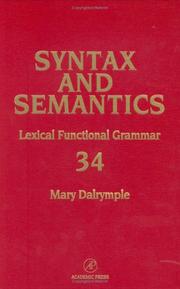 Lexical functional grammarMary Dalrymple · 2001
 Semantics and Syntax in Lexical Functional GrammarMary Dalrymple · 1999
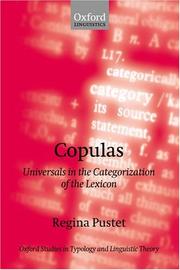 CopulasRegina Pustet · 2003
 Word Meaning and SyntaxStephen Wechsler · 2015
- 📕Give Constructions Across LanguagesMyriam Bouveret · 2021
- 📕Les notions de réception et de production dans le domaine lexical et sémantiqueFrancine Melka-Teichroew · 1989
- 📕Methods of lexical analysisKrzysztof Bogacki, Joanna Ewa Cholewa · 2009
- 📕The representation of lexical semantic informationAnn Copestake · 1992
Ranked by number of editions on Open Library, a rough measure of how lasting a book is.
🔗 Related topics
- Linguistics wars The linguistics wars were extended disputes among American theoretical linguists that occurred mostly during the 1960s and 1970s, stemming from a disagreement…
- Labile verb In general linguistics, a labile verb (or ergative / diffused / ambivalent verb) is a verb that undergoes causative alternation; that is, it can be used…
- Valency (linguistics) In linguistics, valency or valence is the number and type of arguments and complements controlled by a predicate, content verbs being typical predicates…
- Argument (linguistics) In linguistics, an argument is an expression that helps complete the meaning of a predicate, the latter referring in this context to a main verb and its…
- Subcategorization In linguistics, subcategorization denotes the ability/necessity for lexical items (usually verbs) to require/allow the presence and types of the syntactic…
- Volition (linguistics) In linguistics, volition is a concept that distinguishes whether the subject, or agent of a particular sentence intended an action or not. Simply, it is…
- Causative In linguistics, a causative (abbreviated caus) is a valency-increasing operation that indicates that a subject either causes someone or something else…
- Theta role Theta roles are the names of the participant roles associated with a predicate: the predicate may be a verb, an adjective, a preposition, or a noun. If…