Live briefing
Everything about Japanese proverbs
Linguistic family of idiomatic expressions
A Japanese proverb may take the form of:a short saying , an idiomatic phrase , or a four-character idiom . Wikipedia →
🧭 Start here: a 6-step reading path
- Read the overview: Japanese proverbsA 5-minute orientation
- Skim a recent paper: Comparative Analysis on Cattle-related Proverbs between Chinese and Japanese: Based on a Paremiological Spectral ListInfluential work since 2022
- Pick up a classic book: Nihon no kotowazaThe most-reprinted book on the subject
- Read the landmark paper: The Nature of Speech according to Japanese ProverbsCited 12 times
- Go sideways: YojijukugoA closely related topic
- Go sideways: Wake You Up/Ame no Hi ni wa Ame no Naka o Kaze no Hi ni wa Kaze no Naka o/MarvelousA closely related topic
📖 Definitions
No dictionary entry for this exact phrase.
🏆 Landmark papers (most cited)
The Nature of Speech according to Japanese Proverbs
Women in Japanese Proverbs
Metaphors and Cultural Values Part of Plants in Japanese Proverbs
A Comparison of English and Japanese Proverbs Using Natural Semantic Metalanguage
A Semiotic Analysis of Japanese Proverbs Based on Barthes’ Framework
Comparative Ethnolinguistics on Metaphorical Interpretations in Japanese Kotowaza and Malay Proverbs
Japanese Proverbs.
Twenty Japanese Proverbs
🆕 Influential since 2022
Comparative Analysis on Cattle-related Proverbs between Chinese and Japanese: Based on a Paremiological Spectral List
A comparative analysis of English and Japanese proverbs about labour
Analysis of Japanese Proverbs Using the Words “Mizu” and “Ame” and Sundanese Proverbs Using the Words “Cai” and “Hujan”
The Meaning of Japanese Proverbs and Their Equivalents in Indonesian Language
A Comparative Study on Proverbs Related to “Tiger” in Chinese and Japanese
📚 Books worth reading
- 📕Nihon no kotowazaKaneko, Takeo · 1958
- 📕Hyōshaku kotowaza jitenInoue, Minoru · 1969
- 📕Koji seigo daijitenDōmei Kanno · 1907
- 📕Die sprichwörter und bildlichen ausdrücke der japanischen sprachePaul Ehmann · 1897
 Japanese proverbsDavid Galef, Jun Hashimoto · 2012
- 📕Koji kotowaza jitenSuzuki, Tōzō · 1956
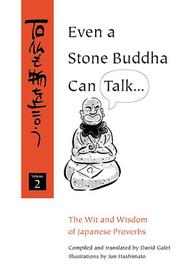 Even a stone Buddha can talkDavid Galef, Jun Hashimoto · 2000
- 📕Koji kotowaza jitenSuzuki, Tōzō · 1961
Ranked by number of editions on Open Library, a rough measure of how lasting a book is.
🔗 Related topics
- Yojijukugo A yojijukugo (Japanese: 四字熟語; pronounced [jo̞ʑiʑɨꜜkɯ̟ɡo̞]) is a Japanese lexeme consisting of four kanji (Chinese characters). English translations of…
- Wake You Up/Ame no Hi ni wa Ame no Naka o Kaze no Hi ni wa Kaze no Naka o/Marvelous Wake You Up/Ame no Hi ni wa Ame no Naka o Kaze no Hi ni wa Kaze no Naka o/Marvelous (雨の日には 雨の中を 風の日には 風の中を, in the rain when it's rainy, in the wind when…
- Japanese particles Japanese particles, joshi (助詞) or teni(o)ha (てに(を)は), are suffixes or short words in Japanese grammar that immediately follow the modified noun, verb,…
- Ame no Hi ni wa Ame no Naka o Kaze no Hi ni wa Kaze no Naka o "Ame no Hi ni wa Ame no Naka o Kaze no Hi ni wa Kaze no Naka o" (雨の日には 雨の中を 風の日には 風の中を, In the Rain When It's Rainy, In the Wind When It's Windy), is the…
- Japanese grammar Japanese is an agglutinative, synthetic, mora-timed language with simple phonotactics, a pure vowel system, phonemic vowel and consonant length, and a…
- Good Pages Good Pages is the series of retrospective album by a Japanese singer-songwriter Yōsui Inoue. The primary edition of Good Pages mainly comprises the songs…
- Boku wa Boku o Suki ni Naru "Boku wa Boku o Suki ni Naru" (Japanese: 僕は僕を好きになる; "I am Starting to Like Myself") is the 26th single by Japanese idol group Nogizaka46. It was released…
- Anapodoton An anapodoton (from Ancient Greek ἀναπόδοτον anapódoton: "that which lacks an apodosis", that is, the consequential clause in a conditional sentence),…