Live briefing

Everything about Inverse transform sampling
Basic method for pseudo-random number sampling
Inverse transform sampling is a basic method for pseudo-random number sampling, i.e., for generating sample numbers at random from any probability distribution given its cumulative distribution function. Wikipedia →
🧭 Start here: a 6-step reading path
- Read the overview: Inverse transform samplingA 5-minute orientation
- Skim a recent paper: Efficient Matrix Polynomial Expansion Detector for Large-Scale MIMO: An Inverse-Transform-Sampling ApproachInfluential work since 2022
- Pick up a classic book: The radon transform, inverse problems, and tomographyThe most-reprinted book on the subject
- Read the landmark paper: Stochastic PCA-Based Bone Models from Inverse Transform Sampling: Proof of Concept for Mandibles and Proximal FemursCited 22 times
- Go sideways: Continuous uniform distributionA closely related topic
- Go sideways: Quantile functionA closely related topic
📖 Definitions
No dictionary entry for this exact phrase.
🏆 Landmark papers (most cited)
Stochastic PCA-Based Bone Models from Inverse Transform Sampling: Proof of Concept for Mandibles and Proximal Femurs
Fuzzy projection versus inverse fuzzy transform as sampling/interpolation schemes
Fast Inverse Transform Sampling of Non‐Gaussian Distribution Functions in Space Plasmas
Inverse transform sampling for efficient Doppler-averaged spectroscopy simulations
ITSO: a novel inverse transform sampling-based optimization algorithm for stochastic search
Inverse Z-transform by Mobius inversion and the error bounds of aliasing in sampling
Compressive Sampling of Polarimetric Doppler Weather Radar Processing Via Inverse Fast Fourier Transform
Inverse Beam Pattern Transform and Spatial Sampling for Uniform Array From Broadband Beamforming Perspective
🆕 Influential since 2022
Efficient Matrix Polynomial Expansion Detector for Large-Scale MIMO: An Inverse-Transform-Sampling Approach
Implementation of inverse transform sampling method for photon transport in Monte Carlo code and nuclear data library preparation by NECP-Atlas
Wave-light-field sampling criteria for inverse-Wigner-transform-based hologram acquisition
Multiple imputation of censored bivariate event-times via inverse transform and nonparametric Gibbs sampling
ISMDNet: Multi-Material Decomposition Using Deep Learning and Inverse Transform Sampling in Spectral Photon Counting CT
📚 Books worth reading
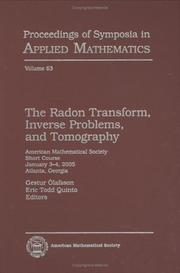 The radon transform, inverse problems, and tomographyGestur Ólafsson · 2006
Ranked by number of editions on Open Library, a rough measure of how lasting a book is.
🔗 Related topics
- Continuous uniform distribution In probability theory and statistics, the continuous uniform distributions or rectangular distributions are a family of symmetric probability distributions…
- Quantile function In probability and statistics, the quantile function of a probability distribution is the inverse of its cumulative distribution function. That is, the…
- Cumulative distribution function In probability theory and statistics, the cumulative distribution function (CDF) of a real-valued random variable X, or just distribution function of X…
- Type-2 Gumbel distribution In probability theory, the Type-2 Gumbel probability density function is f ( x | a , b ) = a b x − a − 1 e − b x − a {\displaystyle \ f(x|a,b)=a\…
- Gumbel distribution In probability theory and statistics, the Gumbel distribution (also known as the type-I generalized extreme value distribution) is used to model the distributio…
- Inverse distribution In probability theory and statistics, an inverse distribution is the distribution of the reciprocal of a random variable. Inverse distributions arise in…
- Probability integral transform In probability theory, the probability integral transform (also known as universality of the uniform) relates to the result that data values that are modeled…
- Binomial regression In statistics, binomial regression is a regression analysis technique in which the response (often referred to as Y) has a binomial distribution: it is…