Live briefing
Everything about Interruption science
Scientific study
Interruption science is the interdisciplinary scientific study concerned with how interruptions affect human performance, and the development of interventions to ameliorate the disruption caused by interruptions. Interruption science is a branch of human factors psychology and emerged from human–computer interaction and cognitive psychology. Wikipedia →
🧭 Start here: a 6-step reading path
- Read the overview: Interruption scienceA 5-minute orientation
- Skim a recent paper: Interruption science as a research field: Towards a taxonomy of interruptions as a foundation for the fieldInfluential work since 2022
- Pick up a classic book: Interrupted time series analysisThe most-reprinted book on the subject
- Read the landmark paper: The science of interruptionCited 77 times
- Go sideways: Cognitive loadA closely related topic
- Go sideways: Human multitaskingA closely related topic
📖 Definitions
Noun The interdisciplinary scientific study of how interruptions affect human performance, and how these disruptions can be mitigated.
🗂️ The subject at a glance
🏆 Landmark papers (most cited)
🆕 Influential since 2022
📚 Books worth reading
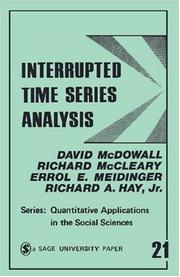 Interrupted time series analysisDavid McDowall, David McDowall · 1980
- 📕Debug and interrupt handling program for the PDP8L. Østergaard · 1967
 Formal Methods Foundations and Applications
Lecture Notes in Computer ScienceJim Woodcock · 2010
 Alternatives in Jewish bioethicsNoʻam Zohar · 1997
Ranked by number of editions on Open Library, a rough measure of how lasting a book is.
🔗 Related topics
- Cognitive load In cognitive psychology, cognitive load is the effort being used in the working memory. According to work conducted in the field of instructional design…
- Human multitasking Human multitasking is a concept that one can split their attention on more than one task or activity at the same time, such as speaking on the phone while…
- Ergonomics Ergonomics, also known as human factors or human factors engineering (HFE), is the scientific study to understand the interaction between humans and other…
- Engineering psychology Engineering psychology is the science of human behavior and capability applied to the design and operation of systems and technology. As an applied field…
- Media multitasking Media multitasking is the concurrent use of multiple digital media streams. Media multitasking has been associated with depressive symptoms and social…
- Attention management Attention management refers to models and tools for supporting the management of attention at the individual or at the collective level (cf. attention…
- Cognitive ergonomics Cognitive ergonomics is a scientific discipline that studies, evaluates, and designs tasks, jobs, products, environments and systems and how they interact…
- Visuospatial ability Visuospatial ability or visual-spatial ability is the ability to mentally manipulate 2-dimensional and 3-dimensional figures. It is typically measured…