Live briefing
Everything about Interprocedural optimization
Computer program optimization method
Interprocedural optimization (IPO) is a collection of compiler techniques used in computer programming to improve performance in programs containing many frequently used functions of small or medium length. IPO differs from other compiler optimizations by analyzing the entire program as opposed to a single function or block of code. Wikipedia →
🧭 Start here: a 6-step reading path
- Read the overview: Interprocedural optimizationA 5-minute orientation
- Pick up a classic book: Optimal interprocedural program optimizationThe most-reprinted book on the subject
- Read the landmark paper: The impact of interprocedural analysis and optimization in the R n programming environmentCited 76 times
- Go sideways: LLVMA closely related topic
- Go sideways: GNU Compiler CollectionA closely related topic
📖 Definitions
No dictionary entry for this exact phrase.
🗂️ The subject at a glance
🏆 Landmark papers (most cited)
The impact of interprocedural analysis and optimization in the R n programming environment
Interprocedural optimization
Interprocedural optimization: Experimental results
Interprocedural control flow analysis of first-order programs with tail-call optimization
Interprocedural optimization: eliminating unnecessary recompilation
Interprocedural Compiler Optimization for Partial Run-Time Reconfiguration
A framework for interprocedural optimization in the presence of dynamic class loading
Developing an interprocedural optimizing compiler
📚 Books worth reading
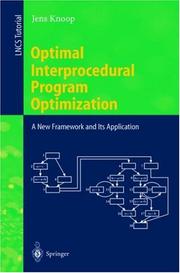 Optimal interprocedural program optimizationJens Knoop · 1998
 Principles of compiler designAlfred V. Aho, Jeffrey D. Ullman · 1977
Ranked by number of editions on Open Library, a rough measure of how lasting a book is.
🔗 Related topics
- LLVM LLVM is a set of compiler and toolchain technologies that can be used to develop a frontend for any programming language and a backend for any instruction…
- GNU Compiler Collection The GNU Compiler Collection (GCC; formerly GNU C Compiler) is a collection of compilers from the GNU Project that support various programming languages…
- Precompiled header In computer programming, a precompiled header (PCH) is a (C or C++) header file that is compiled into an intermediate form that is faster to process for…
- Control-flow integrity Control-flow integrity (CFI) is a general term for computer security techniques that prevent a wide variety of malware attacks from redirecting the flow…
- Clang Clang (/ˈklæŋ/) is a compiler front end for the programming languages C, C++, Objective-C, and Objective-C++ and the software frameworks OpenMP, OpenCL…
- Objective-C Objective-C is a high-level general-purpose, object-oriented programming language that adds Smalltalk-style message passing (messaging) to the C programming…
- Inline (C and C++) In the C and C++ programming languages, an inline function is one qualified with the keyword inline; this serves two purposes: It serves as a compiler…
- Optimizing compiler An optimizing compiler is a compiler designed to generate code that is optimized in aspects such as minimizing program execution time, memory usage, storage…