Everything about Interchangeability algorithm
Technique to solve constraint satisfaction problems
In computer science, an interchangeability algorithm is a technique used to more efficiently solve constraint satisfaction problems (CSP). A CSP is a mathematical problem in which objects, represented by variables, are subject to constraints on the values of those variables; the goal in a CSP is to assign values to the variables that are consistent with the constraints. If two variables A and B in a CSP may be swapped for each other without changing the nature of the problem or its solutions, then A and B are interchangeable variables. Interchangeable variables represent a symmetry of the CSP and by exploiting that symmetry, the search space for solutions to a CSP problem may be reduced. For example, if solutions with A=1 and B=2 have been tried, then by interchange symmetry, solutions with B=1 and A=2 need not be investigated. Wikipedia →
🧭 Start here: a 6-step reading path
- Read the overview: Interchangeability algorithmA 5-minute orientation
- Pick up a classic book: Intelligent Science and Intelligent Data EngineeringThe most-reprinted book on the subject
- Read the landmark paper: On-Orbit Magnetometer Data Calibration Using Genetic Algorithm and Interchangeability of the Calibration ParametersCited 7 times
- Go sideways: Complexity of constraint satisfactionA closely related topic
- Go sideways: Distributed constraint optimizationA closely related topic
📖 Definitions
No dictionary entry for this exact phrase.
🗂️ The subject at a glance
🏆 Landmark papers (most cited)
📚 Books worth reading
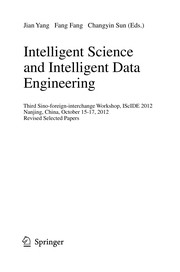 Intelligent Science and Intelligent Data EngineeringJian Yang · 2013
 Data structures using C++D. S. Malik · 2010
 C++ Plus Data StructuresNell Dale, Chip Weems · 2016
- 📕Simulation testing of a fuzzy neural ramp metering algorithmCynthia E. Taylor · 1995
- 📕Security and game theoryMilind Tambe · 2011
- 📕Predictive algorithm improvements for a real-time ramp control systemN. L. Nihan · 1991
 Systems programmingJohn J. Donovan · 1972
- 📕ICTE 2015China) International Conference On Transportation Engineering (5th 2015 Dalian Shi · 2015
Ranked by number of editions on Open Library, a rough measure of how lasting a book is.
🔗 Related topics
- Complexity of constraint satisfaction The complexity of constraint satisfaction is the application of computational complexity theory to constraint satisfaction. It has mainly been studied…
- Distributed constraint optimization Distributed constraint optimization (DCOP or DisCOP) is the distributed analogue to constraint optimization. A DCOP is a problem in which a group of agents…
- Constrained optimization In mathematical optimization, constrained optimization (in some contexts called constraint optimization) is the process of optimizing an objective function…
- Weighted constraint satisfaction problem In artificial intelligence and operations research, a Weighted Constraint Satisfaction Problem (WCSP), also known as Valued Constraint Satisfaction Problem…
- Min-conflicts algorithm In computer science, a min-conflicts algorithm is a search algorithm or heuristic method to solve constraint satisfaction problems. One such algorithm…
- Constraint programming Constraint programming (CP) is a paradigm for solving combinatorial problems that draws on a wide range of techniques from artificial intelligence, computer…
- Constraint satisfaction problem Constraint satisfaction problems (CSPs) are mathematical questions defined as a set of objects whose state must satisfy a number of constraints or limitations…
- Local search (constraint satisfaction) In constraint satisfaction, local search is an incomplete method for finding a solution to a problem. It is based on iteratively improving an assignment…