Everything about Interaural time difference
Difference in time that it takes a sound to travel between two ears

The interaural time difference when concerning humans or animals, is the difference in arrival time of a sound between two ears. It is important in the localization of sounds, as it provides a cue to the direction or angle of the sound source from the head. If a signal arrives at the head from one side, the signal has further to travel to reach the far ear than the near ear. This pathlength difference results in a time difference between the sound's arrivals at the ears, which is detected and aids the process of identifying the direction of sound source. Wikipedia →
🧭 Start here: a 6-step reading path
- Read the overview: Interaural time differenceA 5-minute orientation
- Skim a recent paper: Interaural time difference sensitivity under binaural cochlear implant stimulation persists at high pulse rates up to 900 ppsInfluential work since 2022
- Pick up a classic book: The Neurophysiological Bases of Auditory PerceptionThe most-reprinted book on the subject
- Read the landmark paper: Precise inhibition is essential for microsecond interaural time difference codingCited 484 times
- Go sideways: Superior olivary complexA closely related topic
- Go sideways: Binaural fusionA closely related topic
📖 Definitions
No dictionary entry for this exact phrase.
🏆 Landmark papers (most cited)
Precise inhibition is essential for microsecond interaural time difference coding
Some Measurements of Interaural Time Difference Thresholds
Selectivity for interaural time difference in the owl's midbrain
A Physiologically Based Model of Interaural Time Difference Discrimination
Maps of interaural time difference in the chicken’s brainstem nucleus laminaris
Sensitivity to interaural time difference with bilateral cochlear implants: Development over time and effect of interaural electrode spacing
Cortical Representation of Interaural Time Difference in Congenital Deafness
Effects of Interaural Intensity Difference on the Processing of Interaural Time Difference in the Owl’s Nucleus Laminaris
🆕 Influential since 2022
Interaural time difference sensitivity under binaural cochlear implant stimulation persists at high pulse rates up to 900 pps
Lateralization of interaural time differences with mixed rates of stimulation in bilateral cochlear implant listeners
The Relationship Between Interaural Insertion-Depth Differences, Scalar Location, and Interaural Time-Difference Processing in Adult Bilateral Cochlear-Implant Listeners
Discrimination thresholds for interaural-time differences and interaural-level differences in naïve listeners: Sex differences and learning
A Mixed-Rate Strategy on a Bilaterally-Synchronized Cochlear Implant Processor Offering the Opportunity to Provide Both Speech Understanding and Interaural Time Difference Cues
📚 Books worth reading
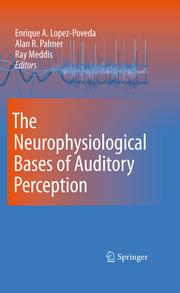 The Neurophysiological Bases of Auditory PerceptionEnrique A. Lopez-Poveda, Alan R. Palmer · 2010
 Echolocation in bats and dolphinsCynthia Moss · 2002
 The new stereo soundbookF. Alton Everest · 1992
 100,000 Years in Detentionjonny Lupsha · 2011
Ranked by number of editions on Open Library, a rough measure of how lasting a book is.
🔗 Related topics
- Superior olivary complex The superior olivary complex (SOC) or superior olive is a collection of brainstem nuclei that is located in pons, functions in multiple aspects of hearing…
- Binaural fusion Binaural fusion or binaural integration is a cognitive process that involves the combination of different auditory information presented binaurally, or…
- Cochlear nucleus The cochlear nucleus (CN) or cochlear nuclear complex comprises two cranial nerve nuclei in the human brainstem, the ventral cochlear nucleus (VCN) and…
- Inferior colliculus The inferior colliculus (IC) (Latin for lower hill) is the principal midbrain nucleus of the auditory pathway and receives input from several peripheral…
- Lateral lemniscus The lateral lemniscus is a tract of axons in the brainstem that carries information about sound from the cochlear nucleus to various brainstem nuclei and…
- Ventral cochlear nucleus In the ventral cochlear nucleus (VCN), auditory nerve fibers enter the brain via the nerve root in the VCN. The ventral cochlear nucleus is divided into…
- Sound localization in owls Most owls are nocturnal or crepuscular birds of prey. Because they hunt at night, they must rely on non-visual senses. Experiments by Roger Payne have…
- Sound localization Sound localization is a listener's ability to identify the location or origin of a detected sound in direction and distance. The sound localization mechanisms…