Live briefing
Everything about Inframarginal analysis
Inframarginal analysis is an analytical method in the study of classical economics. Xiaokai Yang created the super marginal analysis method and revived the important thought of division of labour of Adam Smith. The new classical economics reconstructs several independent economic theories with the core of neoclassical economics from the perspective of endogenous individual choice specialization level by means of inframarginal analysis, which is the frontier subject of economics development. Wikipedia →
🧭 Start here: a 6-step reading path
- Read the overview: Inframarginal analysisA 5-minute orientation
- Pick up a classic book: The economics of e-commerce and networking decisionsThe most-reprinted book on the subject
- Read the landmark paper: An Inframarginal Analysis of the Ricardian ModelCited 19 times
- Go sideways: Xiaokai YangA closely related topic
- Go sideways: Economic returnA closely related topic
📖 Definitions
No dictionary entry for this exact phrase.
🗂️ The subject at a glance
🏆 Landmark papers (most cited)
An Inframarginal Analysis of the Ricardian Model
Inframarginal analysis of division of labor
Inframarginal Model Analysis of the Evolution of Agricultural Division of Labor
A NOTE ON ‘AN INFRAMARGINAL ANALYSIS OF THE RICARDIAN MODEL’
Inframarginal analysis of division of laborA survey
MARGINALVSINFRAMARGINAL ANALYSIS AND THE THEORY OF DISTRIBUTIONVSTHE DEVELOPMENT OF A THEORY OF ECONOMIC ORGANISATION
Inframarginal Analysis of Institute of Firm
INFRAMARGINAL ANALYSIS ON IMPERSONAL NETWORKING DECISIONS, E-COMMERCE, AND BUNDLING SALES
📚 Books worth reading
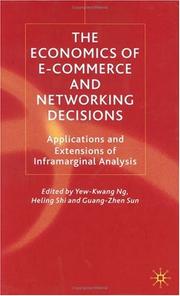 The economics of e-commerce and networking decisionsYew-Kwang Ng, Guang-Zhen Sun · 2003
 The Economics of E-Commerce and Networking DecisionsY. Ng, H. Shi · 2003
- 📕An infra-marginal analysis of the Ricardian modelWen Li Cheng, Jeffrey Sachs · 1999
- 📕Xin xing gu dian jing ji xue yu chao bian ji fenxiXiaokai Yang · 2003
- 📕An inframarginal analysis of the Heckscher-Olin model with transaction costs and technological comparative advantageWen Li Cheng, Xiaokai Yang · 1999
Ranked by number of editions on Open Library, a rough measure of how lasting a book is.
🔗 Related topics
- Xiaokai Yang Xiaokai Yang (born as Yang Xiguang; Simplified Chinese: 杨小凯; 6 October 1948 – 7 July 2004) was a Chinese-Australian economist. He was one of the world's…
- Economic return Economic returns are the gains in output, income, or value, which are generated from the employment of productive inputs or resources. The concept encompasses…
- New classical macroeconomics New classical macroeconomics is a school of thought in macroeconomics based on a neoclassical framework. It emphasizes the importance of foundations based…
- Neoclassical economics Neoclassical economics is an approach to economics in which the production, consumption, and valuation (pricing) of goods and services are observed as…
- Microeconomics Microeconomics is a branch of economics that studies the behavior of individuals and firms in making decisions regarding the allocation of scarce resources…
- Index of economics articles Contents: Top 0–9 A B C D E F G H I J K L M N O P Q R S T U V W X Y Z This aims to be a complete article list of economics topics: Absence rate – Accountancy…
- Neoclassical synthesis The neoclassical synthesis (NCS), or neoclassical–Keynesian synthesis, is an academic movement and paradigm in economics that worked towards reconciling…
- Perfect competition In economics, specifically general equilibrium theory, a perfect market, also known as an atomistic market, is defined by several idealizing conditions…