Everything about Inductive logic programming
Learning logic programs from data

Inductive logic programming (ILP) is a subfield of symbolic artificial intelligence which uses logic programming as a uniform representation for examples, background knowledge and hypotheses. The term "inductive" here refers to philosophical rather than mathematical induction. Given an encoding of the known background knowledge and a set of examples represented as a logical database of facts, an ILP system will derive a hypothesised logic program which entails all the positive and none of the negative examples.Schema: positive examples + negative examples + background knowledge ⇒ hypothesis. Wikipedia →
🧭 Start here: a 6-step reading path
- Read the overview: Inductive logic programmingA 5-minute orientation
- Skim a recent paper: Neuro-Symbolic Inductive Logic Programming with Logical Neural NetworksInfluential work since 2022
- Pick up a classic book: Inductive Logic ProgrammingThe most-reprinted book on the subject
- Read the landmark paper: Inductive Logic Programming: Theory and methodsCited 916 times
- Go sideways: ProgolA closely related topic
- Go sideways: Aleph (ILP)A closely related topic
📖 Definitions
No dictionary entry for this exact phrase.
🗂️ The subject at a glance
🏆 Landmark papers (most cited)
Inductive Logic Programming: Theory and methods
Inductive logic programming
Applications of inductive logic programming
The Connectionist Inductive Learning and Logic Programming System
Inductive Logic Programming At 30: A New Introduction
Scaling Up Inductive Logic Programming by Learning from Interpretations
Inductive logic programming at 30
Model transformation by example using inductive logic programming
🆕 Influential since 2022
Neuro-Symbolic Inductive Logic Programming with Logical Neural Networks
A Critical Review of Inductive Logic Programming Techniques for Explainable AI
Conflict-Driven Inductive Logic Programming
A differentiable first-order rule learner for inductive logic programming
Learning Logic Specifications for Policy Guidance in POMDPs: an Inductive Logic Programming Approach
📚 Books worth reading
 Inductive Logic ProgrammingFabrizio Riguzzi · 2013
 Latest Advances in Inductive Logic ProgrammingStephen Muggleton, Hiroaki Watanabe · 2014
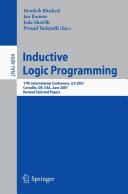 Inductive logic programmingILP 2007 (2007 Corvallis, Or.) · 2008
 Inductive logic programmingStephen Muggleton · 1992
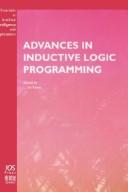 Advances in inductive logic programmingLuc de Raedt · 1996
 Inductive Logic ProgrammingKatsumi Inoue, Hayato Ohwada · 2003
 Inductive Logic ProgrammingPaolo Frasconi · 2011
 Foundations of inductive logic programmingS. -H Nienhuys-Cheng · 1997
Ranked by number of editions on Open Library, a rough measure of how lasting a book is.
🔗 Related topics
- Progol Progol is an implementation of inductive logic programming that combines inverse entailment with general-to-specific search through a refinement graph…
- Aleph (ILP) Aleph (A Learning Engine for Proposing Hypotheses) is an inductive logic programming system introduced by Ashwin Srinivasan in 2001. As of 2022[update]…
- Golem (ILP) Golem is an inductive logic programming algorithm developed by Stephen Muggleton and Cao Feng in 1990. It uses the technique of relative least general…
- Stephen Muggleton Stephen H. Muggleton (born 6 December 1959, son of Louis Muggleton) is Professor of Machine Learning and Head of the Computational Bioinformatics Laboratory…
- Inductive programming Inductive programming (IP) is a special area of automatic programming, covering research from artificial intelligence and programming, which addresses…
- ProbLog ProbLog is a probabilistic logic programming language that extends Prolog with probabilities. It minimally extends Prolog by adding the notion of a probabilisti…
- Markov logic network A Markov logic network (MLN) is a probabilistic logic which applies the ideas of a Markov network to first-order logic, defining probability distributions…
- Theta-subsumption Theta-subsumption (θ-subsumption, or just subsumption) is a decidable relation between two first-order clauses that guarantees that one clause logically…