Live briefing
Everything about Imitative learning
Type of social learning
Imitative learning is a type of social learning whereby new behaviors are acquired via imitation. Imitation aids in communication, social interaction, and the ability to modulate one's emotions to account for the emotions of others, and is "essential for healthy sensorimotor development and social functioning". The ability to match one's actions to those observed in others occurs in humans and animals; This phenomenon has evolutionary roots as it increases an individual's chances of survival in avoiding the costs of individual learning. Wikipedia →
🧭 Start here: a 6-step reading path
- Read the overview: Imitative learningA 5-minute orientation
- Skim a recent paper: Efficient Deep Reinforcement Learning With Imitative Expert Priors for Autonomous DrivingInfluential work since 2022
- Pick up a classic book: Perspectives on imitationThe most-reprinted book on the subject
- Read the landmark paper: Vicarious reinforcement and imitative learning.Cited 454 times
- Go sideways: Social learning in animalsA closely related topic
- Go sideways: ImitationA closely related topic
📖 Definitions
No dictionary entry for this exact phrase.
🗂️ The subject at a glance
🏆 Landmark papers (most cited)
Vicarious reinforcement and imitative learning.
Transformer-Based Imitative Reinforcement Learning for Multirobot Path Planning
Imitative flexibility and the development of cultural learning
Adaptive Quantitative Trading: An Imitative Deep Reinforcement Learning Approach
True Imitative Learning in Pigeons
Mother nurturance and girls incidental imitative learning.
Imitative Learning as a Connector of Collective Brains
Rapid encoding of an internal model for imitative learning
🆕 Influential since 2022
Efficient Deep Reinforcement Learning With Imitative Expert Priors for Autonomous Driving
RLCharge: Imitative Multi-Agent Spatiotemporal Reinforcement Learning for Electric Vehicle Charging Station Recommendation
Interpretable Deep Reinforcement Learning With Imitative Expert Experience for Smart Charging of Electric Vehicles
Human-aligned trading by imitative multi-loss reinforcement learning
Machine Learning Integrated with Model Predictive Control for Imitative Optimal Control of Compression Ignition Engines
📚 Books worth reading
 Perspectives on imitationSusan Hurley, Nick Chater · 2005
 Imitation in human and animal behaviorWanda Wyrwicka · 1996
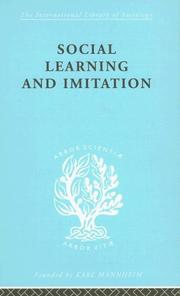 Social learning and imitationNeal E. Miller · 1941
- 📕Imitation in animals and artifactsKerstin Dautenhahn · 2002
 Social learning and imitationNeal E. Miller · 1941
- 📕Social learning and imitationNeal E. Miller · 1947
- 📕The effect of model type on cognitive recognition, form kinematics, and outcome during the initial phase of sport skill acquisitionDiane Marie Wiese · 1989
- 📕Effects of imitative learning on the acquisition of rotary pursuit skill by educable mentally retarded boysMark Edward Nierengarten · 1982
Ranked by number of editions on Open Library, a rough measure of how lasting a book is.
🔗 Related topics
- Social learning in animals Social learning refers to learning that is facilitated by observation of, or interaction with, another animal or its products. Social learning has been…
- Imitation Imitation (from Latin imitatio, "a copying") is a behavior whereby an individual observes and replicates another's behavior. Imitation is also a form of…
- Cultural group selection Cultural group selection is an explanatory model within cultural evolution of how cultural traits evolve according to the competitive advantage they bestow…
- Observational learning Observational learning is learning that occurs through observing the behavior of others. It is a form of social learning which takes various forms, based…
- Emulation (observational learning) In emulation learning, subjects learn about parts of their environment and use this to achieve their own goals and is an observational learning mechanism…
- Bobo doll experiment The Bobo doll experiment was used by psychologist Albert Bandura to test his social learning theory. Between 1961 and 1963, he studied children's behaviour…
- Echopraxia Echopraxia (also known as echokinesis) is the involuntary repetition or imitation of another person's actions. Similar to echolalia, the involuntary repetition…
- Animal culture Animal culture can be defined as the ability of non-human animals to learn and transmit behaviors through processes of social or cultural learning. Culture…