Everything about High-availability cluster
Group of computers that run with minimum downtime
In computing, high-availability clusters or fail-over clusters are groups of computers that support server applications that can be reliably utilized with a minimum amount of down-time. They operate by using high availability software to harness redundant computers in groups or clusters that provide continued service when system components fail. Without clustering, if a server running a particular application crashes, the application will be unavailable until the crashed server is fixed. HA clustering remedies this situation by detecting hardware/software faults, and immediately restarting the application on another system without requiring administrative intervention, a process known as failover. As part of this process, clustering software may configure the node before starting the application on it. For example, appropriate file systems may need to be imported and mounted, network hardware may have to be configured, and some supporting applications may need to be running as well. Wikipedia →
🧭 Start here: a 6-step reading path
- Read the overview: High-availability clusterA 5-minute orientation
- Skim a recent paper: High-availability clusters: A taxonomy, survey, and future directionsInfluential work since 2022
- Pick up a classic book: Treaty Occupationay ToxicologyThe most-reprinted book on the subject
- Read the landmark paper: The Transis approach to high availability cluster communicationCited 171 times
- Go sideways: FailoverA closely related topic
- Go sideways: Red Hat Cluster SuiteA closely related topic
📖 Definitions
No dictionary entry for this exact phrase.
🗂️ The subject at a glance
🏆 Landmark papers (most cited)
The Transis approach to high availability cluster communication
Hox cluster polarity in early transcriptional availability: a high order regulatory level of clustered Hox genes in the mouse
An Analysis of Replication Enhancement for a High Availability Cluster
Optimal Recovery Schemes for High-Availability Cluster and Distributed Computing
Achieving high availability and performance computing with an HA-OSCAR cluster
Efficient and Adaptive Stateful Replication for Stream Processing Engines in High-Availability Cluster
High Availability Server Using Raspberry Pi 4 Cluster and Docker Swarm
STUDY OF HIGH AVAILABILITY AND PERFORMACE OFF SERVER CLUSTER
🆕 Influential since 2022
High-availability clusters: A taxonomy, survey, and future directions
A computationally efficient method for assessing the impact of an active viral cyber threat on a high-availability cluster
Linux cluster programming for high availability with an Oracle instance
Implementasi Kubernetes Cluster untuk High Availability dan Load Balancing SIAK Undiksha
Analisis performansi high availability cluster server menggunakan heartbeat pada private cloud
📚 Books worth reading
 Treaty Occupationay ToxicologySuelen Queiroz · 2010
 Knowledge based bioinformaticsGil Alterovitz, Marco F. Ramoni · 2010
 Tuning Microsoft server clustersRobert W. Buchanan, Robert Buchanan · 2003
 Network and Parallel ComputingJames J. Park · 2012
 NanosystemsK. Eric Drexler · 1992
 Pro Linux High Availability ClusteringSander van Vugt · 2014
- 📕CentOS High AvailabilityMitja Resman · 2015
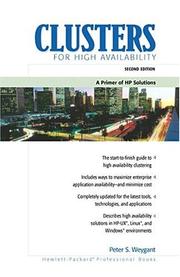 Clusters for High AvailabilityPeter S. Weygant · 2001
Ranked by number of editions on Open Library, a rough measure of how lasting a book is.
🔗 Related topics
- Failover Failover is switching to a redundant or standby computer server, system, hardware component or network upon the failure or abnormal termination of the…
- Red Hat Cluster Suite The Red Hat Cluster Suite (RHCS) includes software to create a high availability and load balancing cluster. Both can be used on the same system although…
- OpenSAF OpenSAF (commonly styled SAF, the Service Availability Framework) is an open-source service-orchestration system for automating computer application deployment…
- N+1 redundancy Redundancy is a form of resilience that ensures system availability in the event of component failure. Components (N) have at least one independent backup…
- DRBD Distributed Replicated Block Device (DRBD) is a distributed replicated storage system for the Linux platform. It mirrors block devices between multiple…
- High availability software High-availability software is software used to ensure that systems are running and available most of the time. High availability is a high percentage of…
- Solaris Cluster Oracle Solaris Cluster (sometimes Sun Cluster or SunCluster) is a high-availability cluster software product for Solaris, originally created by Sun Microsystems…
- Application Interface Specification The Application Interface Specification (AIS) is a collection of open specifications that define the application programming interfaces (APIs) for high-availabi…