Everything about Gabor transform
Special case of the short-time Fourier transform

The Gabor transform, named after Dennis Gabor, is a special case of the short-time Fourier transform. It is used to determine the sinusoidal frequency and phase content of local sections of a signal as it changes over time. The function to be transformed is first multiplied by a Gaussian function, which can be regarded as a window function, and the resulting function is then transformed with a Fourier transform to derive the time-frequency analysis. The window function means that the signal near the time being analyzed will have higher weight. The Gabor transform of a signal x(t) is defined by this formula: Wikipedia →
🧭 Start here: a 6-step reading path
- Read the overview: Gabor transformA 5-minute orientation
- Skim a recent paper: Multi-Scale Learnable Gabor Transform for Pedestrian Trajectory Prediction From Different PerspectivesInfluential work since 2022
- Pick up a classic book: Gabor analysis and algorithmsThe most-reprinted book on the subject
- Read the landmark paper: Complete discrete 2-D Gabor transforms by neural networks for image analysis and compressionCited 1,323 times
- Go sideways: Short-time Fourier transformA closely related topic
- Go sideways: Reassignment methodA closely related topic
📖 Definitions
No dictionary entry for this exact phrase.
🏆 Landmark papers (most cited)
Complete discrete 2-D Gabor transforms by neural networks for image analysis and compression
Discrete Gabor transform
Gabor Transform, SPWVD, Gabor-Wigner Transform and Wavelet Transform - Tools For Power Quality Monitoring
On the discrete Gabor transform and the discrete Zak transform
Down Syndrome Diagnosis Based on Gabor Wavelet Transform
The generalized Gabor transform
Continuous Gabor Transform for Strong Hypergroups
The Gabor transform basis of chromatic monitoring
🆕 Influential since 2022
Multi-Scale Learnable Gabor Transform for Pedestrian Trajectory Prediction From Different Perspectives
The 2-D Hyper-complex Gabor quadratic-phase Fourier transform and uncertainty principles
Bearing failure diagnosis at time-varying speed based on adaptive clustered fractional Gabor transform
Gaborheometry: Applications of the discrete Gabor transform for time resolved oscillatory rheometry
A fractal uncertainty principle for the short-time Fourier transform and Gabor multipliers
📚 Books worth reading
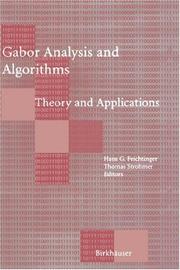 Gabor analysis and algorithmsHans G. Feichtinger, Thomas Strohmer · 1997
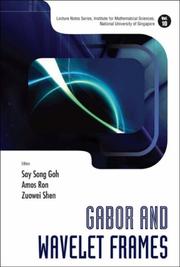 Gabor and wavelet framesʻAmos Ron · 2007
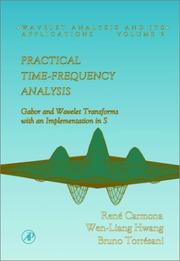 Practical time-frequency analysisR. Carmona · 1998
 Advances in Gabor analysisHans G. Feichtinger, Thomas Strohmer · 2003
Ranked by number of editions on Open Library, a rough measure of how lasting a book is.
🔗 Related topics
- Short-time Fourier transform The short-time Fourier transform (STFT) is a Fourier-related transform used to determine the sinusoidal frequency and phase content of local sections of…
- Reassignment method The method of reassignment is a technique for sharpening a time-frequency representation (e.g. spectrogram or the short-time Fourier transform) by mapping…
- Adaptive Gabor representation Adaptive Gabor representation (AGR) is a Gabor representation of a signal where its variance is adjustable. There's always a trade-off between time resolution…
- Time–frequency analysis for music signals Time–frequency analysis for music signals is one of the applications of time–frequency analysis. Musical sound can be more complicated than human vocal…
- Linear time-invariant system In system analysis, among other fields of study, a linear time-invariant (LTI) system is a system that produces an output signal from any input signal…
- S transform S transform as a time–frequency distribution was developed in 1994 for analyzing geophysics data. In this way, the S transform is a generalization of the…
- Wavelet transform In mathematics, a wavelet series is a representation of a square-integrable (real- or complex-valued) function by a certain orthonormal series generated…
- Discrete-time Fourier transform In mathematics, the discrete-time Fourier transform (DTFT) is a form of Fourier analysis that is applicable to a sequence of discrete values. The DTFT…