Everything about Fixed-effect Poisson model
Statistical models used for static panel data
In statistics, a fixed-effect Poisson model is a Poisson regression model used for static panel data when the outcome variable is count data. Hausman, Hall, and Griliches pioneered the method in the mid-1980s. Their outcome of interest was the number of patents filed by firms, where they wanted to develop methods to control for the firm fixed effects. Linear panel data models use the linear additivity of the fixed effects to difference them out and circumvent the incidental parameter problem. Even though Poisson models are inherently nonlinear, the use of the linear index and the exponential link function lead to multiplicative separability, more specificallyE[yit ∨ xi1... xiT, ci ] = m(xit, ci, b0 ) = exp(ci + xit b0 ) = ai exp(xit b0 ) = μti (1) Wikipedia →
🧭 Start here: a 6-step reading path
- Read the overview: Fixed-effect Poisson modelA 5-minute orientation
- Skim a recent paper: On robust M, S and MM estimations for the Poisson fixed effects panel model with outliers: simulation and applicationsInfluential work since 2022
- Pick up a classic book: Introduction to Probability and StatisticsThe most-reprinted book on the subject
- Read the landmark paper: Gravity model estimation: fixed effects vs. random intercept Poisson pseudo-maximum likelihoodCited 25 times
- Go sideways: Partial likelihood methods for panel dataA closely related topic
- Go sideways: First-difference estimatorA closely related topic
📖 Definitions
No dictionary entry for this exact phrase.
🗂️ The subject at a glance
No outline available.
🏆 Landmark papers (most cited)
Gravity model estimation: fixed effects vs. random intercept Poisson pseudo-maximum likelihood
Robust M Estimation for Poisson Panel Data Model with Fixed Effects: Method, Algorithm, Simulation, and Application
🆕 Influential since 2022
📚 Books worth reading
 Introduction to Probability and StatisticsJ. Susan Milton, Jesse C. Arnold · 1990
- 📕Structural Aspects of Quantum Field Theory and Noncommutative GeometryGerhard Grensing · 2013
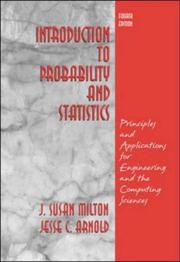 Introduction to probability and statisticsJ. Susan Milton, Jesse C. Arnold · 2002
- 📕Multivariate generalized linear mixed models using RDamon Berridge · 2011
 Statistical methods for drug safetyRobert D. Gibbons · 2016
 Foundation designN. S. V. Kameswara Rao · 2011
Ranked by number of editions on Open Library, a rough measure of how lasting a book is.
🔗 Related topics
- Partial likelihood methods for panel data Partial (pooled) likelihood estimation for panel data is a quasi-maximum likelihood method for panel analysis that assumes that density of yit given xit…
- First-difference estimator In statistics and econometrics, the first-difference (FD) estimator is an estimator used to address the problem of omitted variables with panel data. It…
- Chamberlain's approach to unobserved effects models In linear panel analysis, it can be desirable to estimate the magnitude of the fixed effects, as they provide measures of the unobserved components. For…
- Fractional model In applied statistics, fractional models are, to some extent, related to binary response models. However, instead of estimating the probability of being…
- Discrete-time proportional hazards In survival analysis, hazard rate models are widely used to model duration data in a wide range of disciplines, from bio-statistics to economics. Grouped…
- Unobserved heterogeneity in duration models Issues of heterogeneity in duration models can take on different forms. On the one hand, unobserved heterogeneity can play a crucial role when it comes…
- Simultaneous equations model Simultaneous equations models are a type of statistical model in which the dependent variables are functions of other dependent variables, rather than…
- Dynamic unobserved effects model A dynamic unobserved effects model is a statistical model used in econometrics for panel analysis. It is characterized by the influence of previous values…