Live briefing
Everything about Finite difference
Discrete analog of a derivative
A finite difference is a mathematical expression of the form f(x + b) − f(x + a). Finite differences (or the associated difference quotients) are often used as approximations of derivatives, such as in numerical differentiation. Wikipedia →
🧭 Start here: a 6-step reading path
- Read the overview: Finite differenceA 5-minute orientation
- Skim a recent paper: Finite basis physics-informed neural networks (FBPINNs): a scalable domain decomposition approach for solving differential equationsInfluential work since 2022
- Pick up a classic book: Electromagnetic Simulation Using the FDTD MethodThe most-reprinted book on the subject
- Read the landmark paper: Compact finite difference schemes with spectral-like resolutionCited 5,540 times
- Go sideways: Finite difference methodA closely related topic
- Go sideways: Umbral calculusA closely related topic
📖 Definitions
Noun A difference between the value of a function evaluated at a number, and the value of the same function evaluated at a different number, a fixed distance from the first.
🏆 Landmark papers (most cited)
Compact finite difference schemes with spectral-like resolution
P-SV wave propagation in heterogeneous media; velocity-stress finite-difference method
A survey of several finite difference methods for systems of nonlinear hyperbolic conservation laws
Viscoelastic finite-difference modeling
Mimetic finite difference method
Fourier finite-difference migration
Finite-difference time-domain methods
An asymmetrical finite difference network
🆕 Influential since 2022
Finite basis physics-informed neural networks (FBPINNs): a scalable domain decomposition approach for solving differential equations
Theoretical analysis of the generalized finite difference method
Finite Difference Gradient Approximation: To Randomize or Not?
Distributional finite-difference modelling of seismic waves
A nodal immersed finite element-finite difference method
📚 Books worth reading
 Electromagnetic Simulation Using the FDTD MethodDennis M. Sullivan · 2000
 Computational hydraulicsMichael B. Abbott · 1979
 Numerical electromagneticsUmran S. Inan · 2011
- 📕Finite-difference migration by optimized one-way equationsMyung W. Lee · 1985
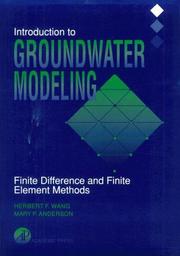 Introduction to groundwater modelingHerbert F. Wang, Mary P. Anderson · 1982
 A practical guide to pseudospectral methodsBengt Fornberg · 1996
 An introduction to the calculus of finite differences and difference equationsKenneth S. Miller · 1960
- 📕Second International Conference "Finite-Difference Methods, Theory and Application" (CFDM98)International Conference "Finite-Difference Methods: Theory and Application" (2nd 1998 Minsk, Belarus) · 1998
Ranked by number of editions on Open Library, a rough measure of how lasting a book is.
🔗 Related topics
- Finite difference method In numerical analysis, finite-difference methods (FDM) are a class of numerical techniques for solving differential equations by approximating derivatives…
- Umbral calculus The term umbral calculus has two related but distinct meanings. In mathematics, before the 1970s, umbral calculus referred to the surprising similarity…
- Linear differential equation In mathematics, a linear differential equation is a differential equation that is linear in the unknown function and its derivatives, so it can be written…
- Second derivative In calculus, the second derivative, or the second-order derivative, of a function f is the derivative of the derivative of f. Informally, the second derivative…
- Taylor series In mathematical analysis, the Taylor series or Taylor expansion of a function is an infinite sum of terms that are expressed in terms of the function's…
- Numerical differentiation In numerical analysis, numerical differentiation algorithms estimate the derivative of a mathematical function or subroutine using values of the function…
- Five-point stencil In numerical analysis, given a square grid in one or two dimensions, the five-point stencil of a point in the grid is a stencil made up of the point itself…
- Bernstein polynomial In the mathematical field of numerical analysis, a Bernstein polynomial is a polynomial expressed as a linear combination of Bernstein basis polynomials…