Everything about Field-programmable gate array
Array of logic gates that are reprogrammable

A field-programmable gate array (FPGA) is a type of configurable integrated circuit that can be repeatedly programmed after manufacturing. FPGAs are a subset of logic devices referred to as programmable logic devices (PLDs). They consist of a grid-connected array of programmable logic blocks that can be configured "in the field" to interconnect with other logic blocks to perform various digital functions. FPGAs are often used in limited (low) quantity production of custom-made products, and in research and development, where the higher cost of individual FPGAs is not as important and where creating and manufacturing a custom circuit would not be feasible. Other applications for FPGAs include the telecommunications, automotive, aerospace, and industrial sectors, which benefit from their flexibility, high signal processing speed, and parallel processing abilities. Wikipedia →
🧭 Start here: a 6-step reading path
- Read the overview: Field-programmable gate arrayA 5-minute orientation
- Skim a recent paper: Field-Programmable Gate Array Architecture for Deep Learning: Survey and Future DirectionsInfluential work since 2022
- Pick up a classic book: FPGA-Based System DesignThe most-reprinted book on the subject
- Read the landmark paper: A Floating-Gate-Based Field-Programmable Analog ArrayCited 111 times
- Go sideways: Complex programmable logic deviceA closely related topic
- Go sideways: Programmable logic deviceA closely related topic
📖 Definitions
Noun a gate array designed to be configured by the customer or designer after manufacturing in the field, i.e. after manufacturing.
🗂️ The subject at a glance
🏆 Landmark papers (most cited)
A Floating-Gate-Based Field-Programmable Analog Array
Field Programmable Gate Array Applications—A Scientometric Review
Fingerprinting techniques for field-programmable gate array intellectual property protection
Floating Gate-Based Field Programmable Mixed-Signal Array
Scaled dielectric antifuse structure for field-programmable gate array applications
Superconducting Magnetic Field Programmable Gate Array
A Task-Schedulable Nonvolatile Spintronic Field-Programmable Gate Array
A field programmable gate array spectrometer for radio astronomy
🆕 Influential since 2022
Field-Programmable Gate Array Architecture for Deep Learning: Survey and Future Directions
Field programmable gate array compression for large array multispeckle diffuse correlation spectroscopy
High-Frequency Systolic Array-Based Transformer Accelerator on Field Programmable Gate Arrays
Field-Programmable Gate Array-Based True Random Number Generator Using Capacitive Oscillators
Parallelized Field-Programmable Gate Array Data Processing for High-Throughput Pulsed-Radar Systems
📚 Books worth reading
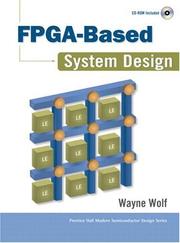 FPGA-Based System DesignWayne Wolf · 2004
 Reconfigurable field programmable gate arrays for mission-critical applicationsNiccolò Battezzati · 2010
 Digital Signal Processing with Field Programmable Gate ArraysUwe Meyer-Baese · 2004
- 📕Applications of Field-Programmable Gate Arrays in Scientific ResearchHartmut F. -W Sadrozinski, Jinyuan Wu · 2010
- 📕FPGA'09ACM International Symposium on Field-Programmable Gate Arrays (17th 2009 Monterey, Calif.) · 2009
 Reconfigurable computingMaya Gokhale, Paul S. Graham · 2005
 Field-programmable gate arraysInternational Workshop on Field-Programmable Logic and Applications (2nd 1992 Vienna, Austria) · 1993
 FPGA '99ACM International Symposium on Field-Programmable Gate Arrays (7th 1999 Monterey, Calif.) · 1999
Ranked by number of editions on Open Library, a rough measure of how lasting a book is.
🔗 Related topics
- Complex programmable logic device A complex programmable logic device (CPLD) is a programmable logic device with complexity between that of programmable array logic (PAL) and field-programmable…
- Programmable logic device A programmable logic device (PLD) is an electronic component used to build reconfigurable digital circuits. Unlike digital logic constructed using discrete…
- Application-specific integrated circuit An application-specific integrated circuit (ASIC /ˈeɪsɪk/) is an integrated circuit (IC) chip customized for a particular use, rather than intended for…
- Quartus Prime Quartus Prime is programmable logic device design software produced by Altera; prior to Intel's separation of Altera, the software was called Intel Quartus…
- Xilinx ISE Xilinx ISE (short for Integrated Synthesis Environment) is a discontinued software tool from Xilinx for synthesis and analysis of HDL designs, which primarily…
- Xilinx Xilinx, Inc. (/ˈzaɪlɪŋks/ ZY-links) was an American technology and semiconductor company that primarily supplied programmable logic devices. The company…
- Soft microprocessor A soft microprocessor (also called softcore microprocessor or a soft processor) is a microprocessor core that can be wholly implemented using logic synthesis…
- Logic block In computing, a logic block or configurable logic block (CLB) is a fundamental building block of field-programmable gate array (FPGA) technology.[citation…