Everything about Field-oriented control
Method to control electric motors
Field-oriented control (FOC), also called vector control, is a variable-frequency drive (VFD) control method in which the stator currents of a three-phase AC motor are identified as two orthogonal components that can be visualized with a vector. One component defines the magnetic flux of the motor, the other the torque. The regulation of magnetic flux in electric drives is sometimes described as flux control, referring to the decoupled control of flux and torque in field-oriented control systems. The control system of the drive calculates the corresponding current component references from the flux and torque references given by the drive's speed control. Typically proportional-integral (PI) controllers are used to keep the measured current components at their reference values. The pulse-width modulation of the variable-frequency drive defines the transistor switching according to the stator voltage references that are the output of the PI current controllers. Wikipedia →
🧭 Start here: a 6-step reading path
- Read the overview: Field-oriented controlA 5-minute orientation
- Skim a recent paper: Performance Comparison of Field-oriented Control, Direct Torque Control, and Model-predictive Control for SynRMsInfluential work since 2022
- Pick up a classic book: The field orientation principle in control of induction motorsThe most-reprinted book on the subject
- Read the landmark paper: Hybrid Control Set-Model Predictive Control for Field-Oriented Control of VSI-PMSMCited 82 times
- Go sideways: Induction generatorA closely related topic
- Go sideways: Direct torque controlA closely related topic
📖 Definitions
No dictionary entry for this exact phrase.
🗂️ The subject at a glance
🏆 Landmark papers (most cited)
Hybrid Control Set-Model Predictive Control for Field-Oriented Control of VSI-PMSM
Analysis and Control of Current Harmonic in IPMSM Field-Oriented Control System
Field-oriented control of saturated induction machines
Direct field oriented control of linear induction motors
Indirect field-oriented control of an induction motor in the field-weakening region
Decoupling Network of Field-Oriented Control in Variable-Frequency Drives
Slip-Frequency Detection for Indirect Field-Oriented Control Drives
Predictive field-oriented control for electric drives
🆕 Influential since 2022
Performance Comparison of Field-oriented Control, Direct Torque Control, and Model-predictive Control for SynRMs
Development of a PMSM motor field-oriented control algorithm for electrical vehicles
Adaptive Cruise Control in Electric Vehicles with Field-Oriented Control
Induction Motor Field-Oriented Sensorless Control with Filter and Long Cable
A Robust Control Strategy for Effective Field-Oriented Control of PMSMs
📚 Books worth reading
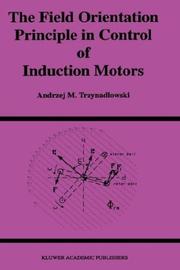 The field orientation principle in control of induction motorsAndrzej Trzynadlowski · 1994
 Fundamentals of Computer Programming with CSharp Free Book (by Nakov & Co.)Svetlin Nakov · 2013
Ranked by number of editions on Open Library, a rough measure of how lasting a book is.
🔗 Related topics
- Induction generator An induction generator (or asynchronous generator) is a type of alternating current (AC) electrical generator that uses the principles of induction motors…
- Direct torque control Direct torque control (DTC) is one method used in variable-frequency drives to control the torque (and thus finally the speed) of three-phase AC electric…
- Synchronous motor A synchronous electric motor is an AC electric motor in which, at steady state, the rotation of the shaft is synchronized with the frequency of the supply…
- Rotor (electric) The rotor is a moving component of an electromagnetic system in the electric motor, electric generator, or alternator. Its rotation is due to the interaction…
- AC motor An AC motor is an electric motor driven by an alternating current (AC). The AC motor commonly consists of two basic parts, an outside stator having coils…
- Electric machine In electrical engineering, an electric machine is a general term for a machine that makes use of electromagnetic forces and their interactions with voltages…
- Armature-controlled DC motor An armature controlled DC motor is a direct current (DC) motor that uses a permanent magnet driven by the armature coils only. A motor is an actuator,…
- Ward Leonard control Ward Leonard control, also known as the Ward Leonard drive system, was a widely used DC motor speed control system introduced by Harry Ward Leonard in…