Live briefing

Everything about Fiber Distributed Data Interface
Standard for data transmission in a local area network
Fiber Distributed Data Interface (FDDI) is a standard for data transmission in a local area network. It uses optical fiber as its standard underlying physical medium. Wikipedia →
🧭 Start here: a 6-step reading path
- Read the overview: Fiber Distributed Data InterfaceA 5-minute orientation
- Pick up a classic book: FDDIThe most-reprinted book on the subject
- Read the landmark paper: An overview of FDDI: the fiber distributed data interfaceCited 207 times
- Go sideways: Fast EthernetA closely related topic
- Go sideways: EthernetA closely related topic
📖 Definitions
No dictionary entry for this exact phrase.
🗂️ The subject at a glance
🏆 Landmark papers (most cited)
An overview of FDDI: the fiber distributed data interface
Error characteristics of fiber distributed data interface (FDDI)
High-Performance Networks: A Focus on the Fiber Distributed Data Interface (FDDI) Standard
Following the fiber distributed data interface
Fiber distributed data interface: throughput evaluation with multiple classes of traffic
Distributed flight control system using fiber distributed data interface (FDDI)
Fiber Distributed Data Interface attachment to System/390
Performance Investigation of Fiber Distributed Data Interface in Networking
📚 Books worth reading
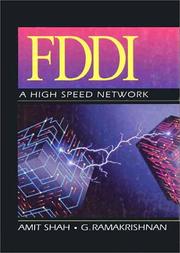 FDDIAmit Shah, G. Ramakrishnan · 1993
 FDDIWendy H. Michael, William J. Cronin · 1992
 FDDI networkingMartin A. W. Nemzow · 1993
 FDDI, technology and applicationsRaman Khanna · 1992
 FDDI handbookRaj Jain · 1994
- 📕High-speed networkingJerry Cashin · 1994
- 📕Planning for the fiber distributed data interface (FDDI)William E Burr · 1993
 FDDI technology reportJohn F. Mazzaferro · 1991
Ranked by number of editions on Open Library, a rough measure of how lasting a book is.
🔗 Related topics
- Fast Ethernet In computer networking, Fast Ethernet physical layers carry traffic at the nominal rate of 100 Mbit/s. The prior Ethernet speed was 10 Mbit/s. Of the Fast…
- Ethernet Ethernet (/ˈiːθərnɛt/ EE-thər-net) is a family of wired computer networking standards designed for (but not limited to) local area networks (LAN), access…
- Ethernet physical layer The physical-layer specifications of the Ethernet family of computer network standards are published by the Institute of Electrical and Electronics Engineers…
- IEEE 802.6 IEEE 802.6 is a standard governed by the ANSI for Metropolitan Area Networks (MAN). It is an improvement of an older standard (also created by ANSI) which…
- Local area network A local area network (LAN) is a computer network that interconnects computers within a limited area such as a residence, campus, or building, and has its…
- 10 Gigabit Ethernet 10 Gigabit Ethernet (10GE, 10GbE, or 10 GigE) is a group of computer networking technologies for transmitting Ethernet frames at a rate of 10 gigabits…
- Token Ring Token Ring is a physical and data link layer computer networking technology used to build local area networks. It was introduced by IBM in 1984 and standardized…
- Distributed-queue dual-bus In telecommunications, a distributed-queue dual-bus network (DQDB) is a distributed multi-access network that (a) supports integrated communications using…