Live briefing
Everything about Fast multipole method
Numerical technique
The fast multipole method (FMM) is a numerical technique that was developed to speed up the calculation of long-ranged forces in the n-body problem. It does this by expanding the system Green's function using a multipole expansion, which allows one to group sources that lie close together and treat them as if they were a single source. Wikipedia →
🧭 Start here: a 6-step reading path
- Read the overview: Fast multipole methodA 5-minute orientation
- Skim a recent paper: Fast Multipole Method for Gravitational Lensing: Application to High-magnification Quasar MicrolensingInfluential work since 2022
- Pick up a classic book: Introduction to the Fast Multipole MethodThe most-reprinted book on the subject
- Read the landmark paper: MAFFT: a novel method for rapid multiple sequence alignment based on fast Fourier transformCited 16,270 times
- Go sideways: Kodaira–Spencer mapA closely related topic
- Go sideways: Smooth maximumA closely related topic
📖 Definitions
No dictionary entry for this exact phrase.
🗂️ The subject at a glance
🏆 Landmark papers (most cited)
MAFFT: a novel method for rapid multiple sequence alignment based on fast Fourier transform
The continuous fast multipole method
The Fast Multipole Method: Numerical Implementation
The black-box fast multipole method
Implementing the fast multipole method in three dimensions
Fast multipole method solution using parametric geometry
A parallel version of the fast multipole method
Efficient fast multipole method for low-frequency scattering
🆕 Influential since 2022
Fast Multipole Method for Gravitational Lensing: Application to High-magnification Quasar Microlensing
Fast multipole boundary element method for the acoustic analysis of finite periodic structures
A fast multipole boundary element method for half-space acoustic problems in a subsonic uniform flow
Accelerated IE-GSTC Solver for Large-Scale Metasurface Field Scattering Problems Using Fast Multipole Method (FMM)
An adaptive h-refinement method for the boundary element fast multipole method for quasi-static electromagnetic modeling
📚 Books worth reading
- 📕Introduction to the Fast Multipole MethodVictor Anisimov, James J. P. Stewart · 2019
 Fast Multipole Boundary Element MethodYijun Liu · 2009
 Fast multipole methods for the Helmholtz equation in three dimensionsNail A. Gumerov · 2004
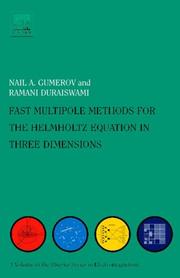 Fast multipole methods for the Helmholtz equation in three dimensions · 2005
 Introduction to Electromagnetic TheoryTai L. Chow · 2005
 Parallelizing the adaptive fast multipole method on a shared memory MIMD machineAnne Greenbaum · 1989
- 📕Multilevel fast multipole method for modeling permeable structures using conformal finite elementsKubilay Sertel · 2003
 Fast multipole boundary element methodYijun Liu · 2009
Ranked by number of editions on Open Library, a rough measure of how lasting a book is.
🔗 Related topics
- Kodaira–Spencer map In mathematics, the Kodaira–Spencer map, introduced by Kunihiko Kodaira and Donald C. Spencer, is a map associated to a deformation of a scheme or complex…
- Smooth maximum In mathematics, a smooth maximum of an indexed family x1, ..., xn of numbers is a smooth approximation to the maximum function max ( x 1 , … , x n ) ,…
- Johnson–Lindenstrauss lemma In mathematics, the Johnson–Lindenstrauss lemma is a result named after William B. Johnson and Joram Lindenstrauss concerning low-distortion embeddings…
- Mean dimension In mathematics, the mean (topological) dimension of a topological dynamical system is a non-negative extended real number that is a measure of the complexity…
- Exponential mechanism The exponential mechanism is a technique for designing differentially private algorithms. It was developed by Frank McSherry and Kunal Talwar in 2007.…
- Dolbeault cohomology In mathematics, in particular in algebraic geometry and differential geometry, Dolbeault cohomology (named after Pierre Dolbeault) is an analog of de Rham…
- Infinitesimal strain theory In continuum mechanics, the infinitesimal strain theory is a mathematical approach to the description of the deformation of a solid body in which the displaceme…
- Proofs involving ordinary least squares The purpose of Proofs involving ordinary least squares page is to provide supplementary materials for the ordinary least squares article, reducing the…