Everything about Dewey Decimal Classification
Library classification system

The Dewey Decimal Classification, colloquially known as the Dewey Decimal System, is a proprietary library classification system which organizes books based on discipline and subject. It was first published in the United States by Melvil Dewey in 1876. Originally described in a 44-page pamphlet, it has been expanded to multiple volumes and revised through 23 major editions, the latest printed in 2011. It is also available in an abridged version suitable for smaller libraries. OCLC, a non-profit cooperative that serves libraries, currently maintains the system and licenses online access to WebDewey, a continuously updated version for catalogers. Wikipedia →
🧭 Start here: a 6-step reading path
- Read the overview: Dewey Decimal ClassificationA 5-minute orientation
- Skim a recent paper: Dewey Decimal Classification (DDC)Influential work since 2022
- Pick up a classic book: Dewey decimal classification and relative indexThe most-reprinted book on the subject
- Read the landmark paper: An extensive study on automated Dewey Decimal ClassificationCited 27 times
- Go sideways: Comparison of Dewey and Library of Congress subject classificationA closely related topic
- Go sideways: Melvil DeweyA closely related topic
📖 Definitions
No dictionary entry for this exact phrase.
🗂️ The subject at a glance
🏆 Landmark papers (most cited)
An extensive study on automated Dewey Decimal Classification
Automated Dewey Decimal Classification of Swedish library metadata using Annif software
Automatic classification of Web resources using Java and Dewey Decimal Classification
Enhancing social tagging with automated keywords from the Dewey Decimal Classification
Automatic Classification of Swedish Metadata Using Dewey Decimal Classification: A Comparison of Approaches
Non-Western Languages and Literatures in the Dewey Decimal Classification Scheme
THE DEVELOPMENT OF THE DEWEY DECIMAL CLASSIFICATION
Searching and Browsing the Dewey Decimal Classification in an Online Catalog
🆕 Influential since 2022
Dewey Decimal Classification (DDC)
How Did We Get Here? Race and Ethnicity in Dewey Decimal Classification
Jogo da Classificação Decimal de Dewey para o ensino da construção de números
Classificação Decimal de Dewey: aplicação das regras de construção de notação
PENGGUNAAN DEWEY DECIMAL CLASSIFICATION OLEH PERPUSTAKAAN AKADEMIK DI INDONESIA
📚 Books worth reading
 Dewey decimal classification and relative indexMelvil Dewey · 1952
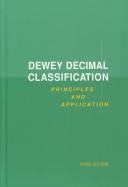 Dewey decimal classificationLois Mai Chan, John P. Comaromi · 1990
- 📕Introduction to Dewey decimal classification for British schoolsMarjorie Chambers · 1961
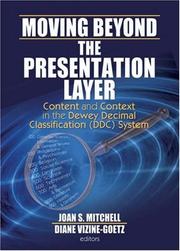 Moving Beyond the Presentation LayerJoan S. Mitchell, Diane Vizine-Goetz · 2007
 Abridged Dewey decimal classification and relative indexMelvil Dewey · 1971
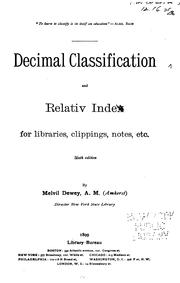 Decimal classification and relativ index for libraries, clippings, notes, etc.Melvil Dewey · 1911
 DDC, Dewey decimal classificationMelvil Dewey · 1980
 Abridged decimal classification and relativ index for libraries, clippings, notes, etc.Melvil Dewey · 1894
Ranked by number of editions on Open Library, a rough measure of how lasting a book is.
🔗 Related topics
- Comparison of Dewey and Library of Congress subject classification The Dewey Decimal and Library of Congress library classification systems are the two most common systems in the United States and among the most popular…
- Melvil Dewey Melville Louis Kossuth "Melvil" Dewey (December 10, 1851 – December 26, 1931) was an American librarian and educator who invented the Dewey Decimal system…
- Natale Battezzati Natale Battezzati (1818–1882) was a printer and publishing house owner in Milan, Italy in the mid- and late 19th-century. He was a founding member of the…
- May Seymour Evelyn May Seymour (August 31, 1857 – June 14, 1921) was an American librarian who collaborated closely with Melvil Dewey on the Dewey Decimal Classification…
- Library of Congress Classification The Library of Congress Classification (LCC)[1] is a system of library classification developed by the Library of Congress in the United States, which…
- Jennie Dorcas Fellows Jennie Dorcas Fellows (April 4, 1873 – October 10, 1938), also known as Dorcas Fellows and Dorkas Fellows, was an author and instructor of library cataloging…
- Korean Decimal Classification The Korean Decimal Classification (KDC) is a system of library classification used in South Korea. The structure and main level classes of the KDC are…
- Library classification A library classification is a system used within a library to organize materials, including books, sound and video recordings, electronic materials, etc…