Everything about Declaration (computer programming)
Programming language construct specifying an identifier's properties
In computer programming, a declaration in a syntactic language construct is the process of specifying identifier properties for its initialization: it declares a word's (identifier's) meaning. Declarations are most commonly used for functions, variables, constants, and classes, but can also be used for other entities such as enumerations and type definitions. Beyond the name and the kind of entity, declarations typically specify the data type, or the type signature ; types may also include dimensions, such as for arrays. A declaration is used to announce the existence of the entity to the compiler; this is important in those strongly typed languages that require functions, variables, and constants, and their types to be specified with a declaration before use, and is used in forward declaration. The term "declaration" is frequently contrasted with the term "definition", but meaning and usage varies significantly between languages; see below. Wikipedia →
🧭 Start here: a 6-step reading path
- Read the overview: Declaration (computer programming)A 5-minute orientation
- Pick up a classic book: Practical aspects of declarative languagesThe most-reprinted book on the subject
- Go sideways: Compatibility of C and C++A closely related topic
- Go sideways: Scope (computer programming)A closely related topic
📖 Definitions
No dictionary entry for this exact phrase.
🗂️ The subject at a glance
🏆 Landmark papers (most cited)
- No matching papers found.
📚 Books worth reading
 Practical aspects of declarative languagesEnrico Pontelli · 2000
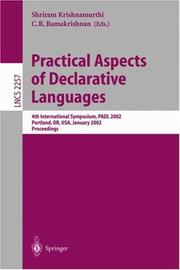 Practical aspects of declarative languagesPADL 2002 (2002 Portland, Or.) · 2002
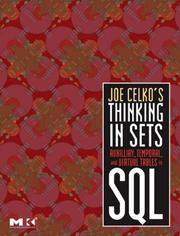 Joe Celko's thinking in setsJoe Celko · 2008
 Specification and verification of declarative open interaction modelsMarco Montali · 2010
- 📕PPDP '07ACM SIGPLAN Symposium on Principles and Practice of Declarative Programming (9th 2007 Wroclaw, Poland) · 2007
 Declarative programming, Sasbachwalden 1991Phoenix Seminar and Workshop on Declarative Programming (1991 Sasbachwalden, Germany) · 1992
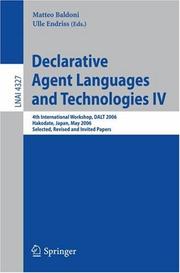 Declarative agent languages and technologies IVMatteo Baldoni · 2007
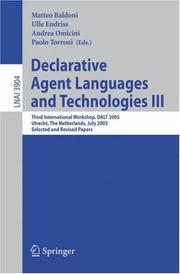 Declarative agent languages and technologies IIIMatteo Baldoni, Andrea Omicini · 2006
Ranked by number of editions on Open Library, a rough measure of how lasting a book is.
🔗 Related topics
- Compatibility of C and C++ The C and C++ programming languages are closely related but have many significant differences. C++ began as a fork of an early, pre-standardized C, called…
- Scope (computer programming) In computer programming, the scope of a name binding (an association of a name to an entity, such as a variable) is the part of a program in which the…
- Forward declaration In computer programming, a forward declaration is a declaration of an identifier (denoting an entity such as a type, a variable, a constant, or a function)…
- C Sharp syntax This article describes the syntax of the C# programming language. The features described are compatible with .NET Framework and Mono. An identifier is…
- Virtual function In object-oriented programming such as is often used in C++ and Object Pascal, a virtual function or virtual method is an inheritable and overridable function…
- Comparison of programming languages (object-oriented programming) This comparison of programming languages compares how object-oriented programming languages such as C++, Java, Smalltalk, Object Pascal, Perl, Python,…
- Type signature In computer science, a type signature or type annotation defines the inputs and outputs of a function, subroutine or method.[citation needed] A type signature…
- List of Java keywords In the Java programming language, a keyword is any one of 68 reserved words that have a predefined meaning in the language. Because of this, programmers…