Live briefing
Everything about DMAIC
Data-driven improvement cycle used for improving and optimizing business processes
DMAIC or define, measure, analyze, improve and control refers to a data-driven improvement cycle used for optimizing and stabilizing business processes and designs. The DMAIC improvement cycle is the core tool used to drive Six Sigma projects. However, DMAIC is not exclusive to Six Sigma and can be used as the framework for other improvement applications. Wikipedia →
🧭 Start here: a 6-step reading path
- Read the overview: DMAICA 5-minute orientation
- Skim a recent paper: The performance improvement analysis using Six Sigma DMAIC methodology: A case study on Indian manufacturing companyInfluential work since 2022
- Pick up a classic book: Six Sigma+Lean toolsetThe most-reprinted book on the subject
- Read the landmark paper: An analysis of the Six Sigma DMAIC method from the perspective of problem solvingCited 315 times
- Go sideways: PDCAA closely related topic
- Go sideways: Eight disciplines problem solvingA closely related topic
📖 Definitions
No dictionary entry for this exact phrase.
🗂️ The subject at a glance
🏆 Landmark papers (most cited)
An analysis of the Six Sigma DMAIC method from the perspective of problem solving
Integration of Industry 4.0 technologies into Lean Six Sigma DMAIC: a systematic review
Integrating DMAIC approach of Lean Six Sigma and theory of constraints toward quality improvement in healthcare
A Six Sigma and DMAIC application for the reduction of defects in a rubber gloves manufacturing process
Structural equation modelling on knowledge creation in Six Sigma DMAIC project and its impact on organizational performance
Using Six Sigma DMAIC to Improve the Quality of the Production Process: A Case Study
Improving performances of the knee replacement surgery process by applying DMAIC principles
Application of lean Six Sigma methodology using DMAIC approach for the improvement of bogie assembly process in the railcar industry
🆕 Influential since 2022
The performance improvement analysis using Six Sigma DMAIC methodology: A case study on Indian manufacturing company
Define, Measure, Analyze, Improve, Control (DMAIC) Methodology as a Roadmap in Quality Improvement
A DMAIC Framework to Improve Quality and Sustainability in Additive Manufacturing—A Case Study
Defect reduction using DMAIC and Lean Six Sigma: a case study in a manufacturing car parts supplier
Quality 4.0 – an evolution of Six Sigma DMAIC
📚 Books worth reading
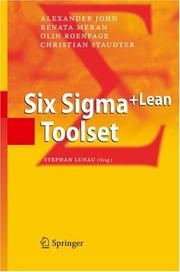 Six Sigma+Lean toolsetAlexander John, Renata Meran · 2008
 Six Sigma+Lean ToolsetAlexander John, Renata Meran
Ranked by number of editions on Open Library, a rough measure of how lasting a book is.
🔗 Related topics
- PDCA PDCA (plan–do–check–act), sometimes called plan–do–check–adjust is an iterative design and management method used in business for the control and continual…
- Eight disciplines problem solving Eight Disciplines Methodology (8D) is a method or model developed at Ford Motor Company used to approach and to resolve problems, typically employed by…
- Root-cause analysis In science and reliability engineering, root-cause analysis (RCA) is a method of problem solving used for identifying the root causes of faults or problems…
- Six Sigma Six Sigma (6σ) is a set of techniques and tools for process improvement. It was introduced by American engineer Bill Smith while working at Motorola in…
- Kaizen Kaizen (Japanese: 改善; "improvement") is a Japanese vocabulary word that outside of Japan has been adopted as a concept in business studies which asserts…
- Index of quality engineering articles This is an alphabetical list of articles pertaining specifically to quality engineering. Contents: A B C D E F G H I J K L M N O P Q R S T U V W X Y Z…
- Ishikawa diagram Ishikawa diagrams (also called fishbone diagrams, herringbone diagrams, cause-and-effect diagrams) are causal diagrams created by Kaoru Ishikawa that show…
- Corrective and preventive action Corrective and preventive action (CAPA or simply corrective action) consists of improvements to an organization's processes taken to eliminate causes of…