Live briefing
Everything about Counting problem (complexity)
Type of computational problem
In computational complexity theory and computability theory, a counting problem is a type of computational problem that is obtained by strengthening a decision problem. Wikipedia →
🧭 Start here: a 6-step reading path
- Read the overview: Counting problem (complexity)A 5-minute orientation
- Skim a recent paper: Complexity of fixed point counting problems in Boolean networksInfluential work since 2022
- Pick up a classic book: Discrete Mathematics and Its ApplicationsThe most-reprinted book on the subject
- Read the landmark paper: The Parameterized Complexity of Counting ProblemsCited 153 times
- Go sideways: Parsimonious reductionA closely related topic
- Go sideways: TFNPA closely related topic
📖 Definitions
No dictionary entry for this exact phrase.
🗂️ The subject at a glance
🏆 Landmark papers (most cited)
The Parameterized Complexity of Counting Problems
Complexity of Generalized Satisfiability Counting Problems
The Relative Complexity of Approximate Counting Problems
The Complexity of Planar Counting Problems
The complexity of the counting constraint satisfaction problem
The Complexity of Counting Problems in Equational Matching
Rational transductions and complexity of counting problems
Counting Complexity of Solvable Black-Box Group Problems
🆕 Influential since 2022
📚 Books worth reading
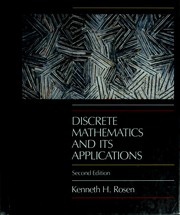 Discrete Mathematics and Its ApplicationsKenneth H. Rosen · 1988
 Think Like a FreakSteven D. Levitt, Stephen J. Dubner · 2014
 Mathematical structures for computer scienceJudith L. Gersting · 1982
 Operations ManagementRoberta S. Russell, Bernard Taylor · 1998
 Advanced engineering mathematicsPeter V. O'Neil · 1983
 Mathematical Methods in the Physical SciencesMary L. Boas, Mary Layne Boas · 1966
 Language and Automata Theory and ApplicationsAdrian-Horia Dediu · 2012
 Writing FirstLaurie G. Kirszner · 1999
Ranked by number of editions on Open Library, a rough measure of how lasting a book is.
🔗 Related topics
- Parsimonious reduction In computational complexity theory and game complexity, a parsimonious reduction is a transformation from one problem to another (a reduction) that preserves…
- TFNP In computational complexity theory, the complexity class TFNP is the class of total function problems that can be solved in nondeterministic polynomial…
- Polynomial-time counting reduction In the computational complexity theory of counting problems, a polynomial-time counting reduction is a type of reduction (a transformation from one problem…
- P (complexity) In computational complexity theory, P, also known as PTIME or DTIME(nO(1)), is a fundamental complexity class. It contains all decision problems that can…
- Many-one reduction In computability theory and computational complexity theory, a many-one reduction (also called mapping reduction) is a reduction that converts instances…
- Computational complexity theory In theoretical computer science and mathematics, computational complexity theory focuses on classifying computational problems according to their resource…
- ♯P In computational complexity theory, the complexity class #P (pronounced "sharp P" or, sometimes "number P" or "hash P") is the set of the counting problems…
- Combinatorial optimization Combinatorial optimization is a subfield of mathematical optimization that consists of finding an optimal object from a finite set of objects, where the…