Everything about Connection-oriented communication
Communication protocol property
In telecommunications and computer networking, connection-oriented communication is a communication protocol where a communication session or a semi-permanent connection is established before any useful data can be transferred. The established connection ensures that data is delivered in the correct order to the upper communication layer. The alternative is called connectionless communication, such as the datagram mode communication used by Internet Protocol (IP) and User Datagram Protocol (UDP), where data may be delivered out of order, since different network packets are routed independently and may be delivered over different paths. Wikipedia →
🧭 Start here: a 6-step reading path
- Read the overview: Connection-oriented communicationA 5-minute orientation
- Skim a recent paper: Presentation as art-oriented extra linguistic object for creating content basis and forming communicative motivation in connection with online foreign language communication teachingInfluential work since 2022
- Pick up a classic book: Extradition laws and treaties, United StatesThe most-reprinted book on the subject
- Read the landmark paper: Linear Quadratic Optimal Discrete-Time Sliding-Mode Controller for Connection-Oriented Communication NetworksCited 39 times
- Go sideways: Virtual circuitA closely related topic
- Go sideways: Connectionless communicationA closely related topic
📖 Definitions
No dictionary entry for this exact phrase.
🗂️ The subject at a glance
🏆 Landmark papers (most cited)
Linear Quadratic Optimal Discrete-Time Sliding-Mode Controller for Connection-Oriented Communication Networks
Discrete Time Sliding Mode Flow Controller for Multi-source Single-bottleneck Connection-oriented Communication Networks
Linear quadratic optimal sliding mode flow control for connection‐oriented communication networks
Nonlinear flow control strategies for connection-oriented communication networks
Finite-time sliding mode flow control design via reduced model for a connection-oriented communication network
An optimal sliding mode congestion controller for connection-oriented communication networks with lossy links
Discrete time congestion controllers for multi-source connection-oriented communication networks
Performance evaluation of massively parallel and high speed connectionless vs. connection oriented communication sessions
🆕 Influential since 2022
📚 Books worth reading
 Extradition laws and treaties, United StatesUnited States · 1795
 The Art of Public SpeakingStephen E. Lucas · 1983
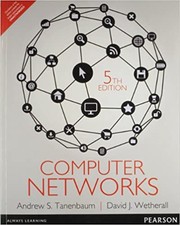 Computer NetworksAndrew S. Tanenbaum, John David Wetherall · 1981
 Computational Linguistics and Intelligent Text ProcessingAlexander Gelbukh · 2003
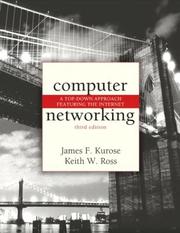 Computer networkingJames F. Kurose, Keith W. Ross · 1900
 Technical CommunicationJohn M. Lannon · 2000
 Technical CommunicationJohn M. Lannon, Laura J. Gurak · 2007
 The personal MBAJosh Kaufman · 2010
Ranked by number of editions on Open Library, a rough measure of how lasting a book is.
🔗 Related topics
- Virtual circuit A virtual circuit (VC) is a means of transporting data over a data network, based on packet switching and in which a connection is first established across…
- Connectionless communication Connectionless communication, often referred to as CL-mode communication, is a data transmission method used in packet switching networks, using data packets…
- ATM Adaptation Layer 5 ATM Adaptation Layer 5 (AAL5) is an ATM adaptation layer used to send variable-length packets up to 65,535 octets in size across an Asynchronous Transfer…
- Datagram A datagram is a basic transfer unit associated with a packet-switched network. Datagrams are typically structured in header and payload sections. Datagrams…
- User Datagram Protocol In computer networking, the User Datagram Protocol (UDP) is one of the core communication protocols of the Internet protocol suite used to send messages…
- Edge device In computer networking, an edge device is a device that provides an entry point into enterprise or service provider core networks. Examples include routers…
- Multiprotocol Label Switching Multiprotocol Label Switching (MPLS) is a routing technique in telecommunications networks that directs data from one node to the next based on labels…
- Statistical time-division multiplexing Statistical multiplexing is a type of digital communication link sharing, sometimes abbreviated as STDM. It is very similar to dynamic bandwidth allocation…