Everything about Computer access control
Ways of controlling usage of a computer
In computer security, general access control includes identification, authorization, authentication, access approval, and audit. A more narrow definition of access control would cover only access approval, whereby the system makes a decision to grant or reject an access request from an already authenticated subject, based on what the subject is authorized to access. Authentication and access control are often combined into a single operation, so that access is approved based on successful authentication, or based on an anonymous access token. Authentication methods and tokens include passwords, biometric scans, physical keys, electronic keys and devices, hidden paths, social barriers, and monitoring by humans and automated systems. Wikipedia →
🧭 Start here: a 6-step reading path
- Read the overview: Computer access controlA 5-minute orientation
- Skim a recent paper: Computable Access Control: Embedding Access Control Rules Into Euclidean SpaceInfluential work since 2022
- Pick up a classic book: Access Control, Security, and TrustThe most-reprinted book on the subject
- Read the landmark paper: Collision-Free Access Control for Computer Communication Bus NetworksCited 20 times
- Go sideways: Attribute-based access controlA closely related topic
- Go sideways: Role-based access controlA closely related topic
📖 Definitions
No dictionary entry for this exact phrase.
🏆 Landmark papers (most cited)
Collision-Free Access Control for Computer Communication Bus Networks
Computer-supported access control
Visual Computer-Managed Security: A Framework for Developing Access Control in Enterprise Applications
Towards more pro-active access control in computer systems and networks
Two integrated schemes of user authentication and access control in a distributed computer network
Authentication and discretionary access control in computer networks
Authentication and discretionary access control in computer networks
Genetic Algorithms for Solving Problems of Access Control Design and Reconfiguration in Computer Networks
🆕 Influential since 2022
Computable Access Control: Embedding Access Control Rules Into Euclidean Space
Analysis and Application of Access Control List (ACL) Methods on Computer Networks
Automated Vehicle Access Control System Utilizing Computer Vision-Based License Plate Recognition
An RFID Based Access Control System operating with a Computer Program and a Database
Trilattice-Based Access Control Models: How to Secure Current Computer Network Mikhail
📚 Books worth reading
 Access Control, Security, and TrustShiu-Kai Chin, Susan Beth Older · 2009
- 📕Attribute-Based Encryption and Access ControlDijiang Huang, Qiuxiang Dong · 2020
- 📕Electronic Access ControlThomas L. Norman · 2011
- 📕A revised model for role-based access controlW. A. Janson · 1998
 Access controlledRonald Deibert · 2010
 Access control, authentication, and public key infrastructureBill Ballad · 2011
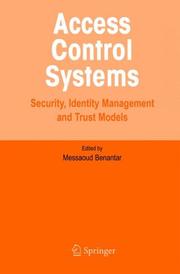 Access control systemsMessaoud Benantar · 2005
- 📕A revised model for role-based access controlW. A Janson · 1998
Ranked by number of editions on Open Library, a rough measure of how lasting a book is.
🔗 Related topics
- Attribute-based access control Attribute-based access control (ABAC), also known as policy-based access control for IAM, defines an access control paradigm whereby a subject's authorization…
- Role-based access control In information security, role-based access control (RBAC) or role-based security is an approach to restricting system access to authorized users. It is…
- Discretionary access control In computer security, discretionary access control (DAC) is a type of access control defined by the Trusted Computer System Evaluation Criteria (TCSEC)…
- Mandatory access control In computer security, mandatory access control (MAC) refers to a type of access control by which a secured environment (e.g., an operating system or a…
- Access control In physical security and information security, access control (AC) is the action of deciding whether a subject should be granted or denied access to an…
- Delegation (computer security) Delegation is the process of a computer user handing over its authentication credentials to another user. In role-based access control models, delegation…
- Authorization Authorization or authorisation (see spelling differences), in information security, computer security and IAM (Identity and Access Management), is the…
- PERMIS PERMIS (PrivilEge and Role Management Infrastructure Standards) is a sophisticated policy-based authorization system that implements an enhanced version…