Everything about Comma
Punctuation mark (,)
The comma , is a punctuation mark that appears in several variants in different languages. Some typefaces render it as a small line, slightly curved or straight, but inclined from the vertical; others give it the appearance of a miniature filled-in figure 9 placed on the baseline. In many typefaces it is the same shape as an apostrophe or single closing quotation mark ’. Wikipedia →
🧭 Start here: a 6-step reading path
- Read the overview: CommaA 5-minute orientation
- Skim a recent paper: CoMMa: A GIS geomorphometry toolbox to map and measure confined landformsInfluential work since 2022
- Pick up a classic book: Eats, Shoots & LeavesThe most-reprinted book on the subject
- Read the landmark paper: Effects of Habitat Patch Size and Isolation on Dispersal by Hesperia comma Butterflies: Implications for Metapopulation StructureCited 297 times
- Go sideways: Parenthetical phraseA closely related topic
- Go sideways: Full stopA closely related topic
📖 Definitions
Noun The punctuation mark ⟨,⟩ used to indicate a set of parts of a sentence or between elements of a list.
Noun A similar-looking subscript diacritical mark.
Noun Anything resembling or having the shape of a comma.
Noun Any of various nymphalid butterflies of the genus Polygonia, having a comma-shaped white mark on the underwings, especially Polygonia c-album and Polygonia c-aureum of North Africa, Europe, and Asia.
🗂️ The subject at a glance
🏆 Landmark papers (most cited)
Effects of Habitat Patch Size and Isolation on Dispersal by Hesperia comma Butterflies: Implications for Metapopulation Structure
Airflow Through Midlatitude Cyclones and the Comma Cloud Pattern
Comparative Molecular Moment Analysis (CoMMA): 3D-QSAR without Molecular Superposition
Comma-Free Codes
The Results, Indications, and Physiology of Posteroventral Pallidotomy for Patients with Parkinson's Disease
The comma sign: An arthroscopic guide to the torn subscapularis tendon
Prosodic Boundaries, Comma Rules, and Brain Responses: The Closure Positive Shift in ERPs as a Universal Marker for Prosodic Phrasing in Listeners and Readers
Comma hairs: A dermatoscopic marker for tinea capitis
🆕 Influential since 2022
CoMMa: A GIS geomorphometry toolbox to map and measure confined landforms
Does Comma Selection Help to Cope with Local Optima?
Morphology and phylogeny of two anaerobic freshwater ciliates: Brachonella comma sp. nov. and the widely distributed but little‐known caenomorphid, Ludio parvulus Penard, 1922
Recommended measurement instruments for menopausal vasomotor symptoms: the COMMA (Core Outcomes in Menopause) consortium
Recommended measurement instruments for genitourinary symptoms associated with menopause: the COMMA (Core outcomes in menopause) consortium
📚 Books worth reading
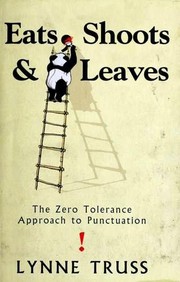 Eats, Shoots & LeavesLynne Truss, FRANK McCOURT · 2002
- 📕KommaIlka Lemke · 2020
 Eats, Shoots & Leaves. Why commas really do make a difference!Lynne Truss · 2006
 Donde Va LA ComaFernando Avila · 2001
- 📕Zapi͡a︡tai͡a︡ kak semantiko-sintaksicheskiĭ signalL. I. Zilʹberman · 1973
 A vi rgulaCelso Pedro Luft · 1996
- 📕De geschiedenis van de kommaWim Daniëls · 1994
- 📕Komma, hvornår og hvorfor?Henrik Galberg Jacobsen, Mogens Gradenwitz · 1993
Ranked by number of editions on Open Library, a rough measure of how lasting a book is.
🔗 Related topics
- Parenthetical phrase In rhetoric, a parenthesis (pl.: parentheses) or parenthetical phrase is an explanatory or qualifying word, phrase, clause, or sentence inserted into a…
- Full stop The full stop (Commonwealth English), period (North American English), or full point (.), is a punctuation mark used for several purposes, most often to…
- Quotation marks in English In English writing, quotation marks or inverted commas, also known informally as quotes, talking marks, speech marks, quote marks, quotemarks or speechmarks…
- Serial comma The serial comma (also referred to as the Oxford comma or Harvard comma) is a comma placed after the penultimate term in a list (just before the conjunction)…
- English punctuation Punctuation in the English language helps the reader to understand a sentence through visual means other than just the letters of the alphabet. English…
- Colon (punctuation) The colon, :, is a punctuation mark consisting of two equally sized dots aligned vertically. A colon often precedes an explanation, a list, or a quoted…
- Semicolon The semicolon ; (or semi-colon) is a symbol commonly used as orthographic punctuation. In the English language, a semicolon is most commonly used to link…
- Dash The dash is a punctuation mark consisting of a long horizontal line. It is similar in appearance to the hyphen but is longer and sometimes higher from…