Live briefing
Everything about Code generation (compiler)
Converting computer code into a machine readable form
In computing, code generation is part of the process chain of a compiler, in which an intermediate representation of source code is converted into a form that the target system can readily execute. Wikipedia →
🧭 Start here: a 6-step reading path
- Read the overview: Code generation (compiler)A 5-minute orientation
- Skim a recent paper: Formally Verified Native Code Generation in an Effectful JIT: Turning the CompCert Backend into a Formally Verified JIT CompilerInfluential work since 2022
- Pick up a classic book: The compiler design handbookThe most-reprinted book on the subject
- Read the landmark paper: Retargetable Compiler Code GenerationCited 59 times
- Go sideways: History of compiler constructionA closely related topic
- Go sideways: CompilerA closely related topic
📖 Definitions
No dictionary entry for this exact phrase.
🗂️ The subject at a glance
🏆 Landmark papers (most cited)
Retargetable Compiler Code Generation
The Intel IA-64 compiler code generator
Program analysis and code generation in an APL/370 compiler
Code Generation in the Columbia Esterel Compiler
On code generation in a PASCAL compiler
Microprocessor architectures: a comparison based on code generation by compiler
Fast, effective code generation in a just-in-time Java compiler
Compiler-based code generation and autotuning for geometric multigrid on GPU-accelerated supercomputers
🆕 Influential since 2022
Formally Verified Native Code Generation in an Effectful JIT: Turning the CompCert Backend into a Formally Verified JIT Compiler
Automatic compiler/interpreter generation from programs for Domain-Specific Languages: Code bloat problem and performance improvement
Finding Compiler Bugs through Cross-Language Code Generator and Differential Testing
Threaded Code Generation with a Meta-Tracing JIT Compiler.
Code Generation Techniques in Compiler Design: Conceptual and Structural Review
📚 Books worth reading
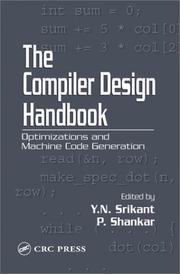 The compiler design handbookY. N. Srikant, P. Shankar · 2002
 The compiler design handbookPriti Shankar · 2007
 Principles of CompilersYunlin Su · 2011
- 📕Report on the validity of 16 NYCRR Part 815New York (State). Legislature. Administrative Regulations Review Commission. · 1991
- 📕Code generator writing systemsHans Lunell · 1983
 The compiler design handbook · 2007
- 📕International Symposium on Code Generation and OptimizationInternational Symposium on Code Generation and Optimization (3rd 2005 San Jose, Calif.) · 2005
- 📕International Symposium on Code Generation and Optimization · 2002
Ranked by number of editions on Open Library, a rough measure of how lasting a book is.
🔗 Related topics
- History of compiler construction In computing, a compiler is a computer program that transforms source code written in a programming language or computer language (the source language)…
- Compiler In computing, a compiler is software that translates computer code written in one programming language (the source language) into another language (the…
- Compiler-compiler In computer science, a compiler-compiler or compiler generator is a programming tool that creates a parser, interpreter, or compiler from some form of…
- GNU Bison GNU Bison, commonly known as Bison, is a parser generator that is part of the GNU Project. Bison reads a specification in Bison syntax (described as "machine-re…
- XPL XPL, for expert's programming language is a programming language based on PL/I, a portable one-pass compiler written in its own language, and a parser…
- Parsing Parsing, syntax analysis, or syntactic analysis is a process of analyzing a string of symbols, either in natural language, computer languages or data structures…
- Lexical analysis Lexical tokenization is conversion of a text into (semantically or syntactically) meaningful lexical tokens belonging to categories defined by a "lexer"…
- Lex (software) Lex is a computer program that generates lexical analyzers ("scanners" or "lexers"). It is commonly used with the yacc parser generator and is the standard…