Everything about Cluster analysis
Grouping a set of objects by similarity

Cluster analysis, or clustering, is a data analysis technique aimed at partitioning a set of objects into groups such that objects within the same group exhibit greater similarity to one another than to those in other groups (clusters). It is a main task of exploratory data analysis, and a common technique for statistical data analysis, used in many fields, including pattern recognition, image analysis, information retrieval, bioinformatics, data compression, computer graphics and machine learning. Wikipedia →
🧭 Start here: a 6-step reading path
- Read the overview: Cluster analysisA 5-minute orientation
- Skim a recent paper: K-means clustering algorithms: A comprehensive review, variants analysis, and advances in the era of big dataInfluential work since 2022
- Pick up a classic book: Data ClusteringThe most-reprinted book on the subject
- Read the landmark paper: Silhouettes: A graphical aid to the interpretation and validation of cluster analysisCited 19,310 times
- Go sideways: Automatic clustering algorithmsA closely related topic
- Go sideways: K-means clusteringA closely related topic
📖 Definitions
Noun The classification of objects into different groups, or more precisely, the partitioning of a data set into subsets (clusters), so that the data in each subset (ideally) share some common trait - often proximity according to some defined distance measure.
🗂️ The subject at a glance
🏆 Landmark papers (most cited)
Silhouettes: A graphical aid to the interpretation and validation of cluster analysis
Hierarchical Cluster Analysis
Bayesian cluster analysis
Cluster analysis
Cluster analysis
Bicriterion Cluster Analysis
Cluster Correspondence Analysis
Cluster Analysis in Diagnosis
🆕 Influential since 2022
K-means clustering algorithms: A comprehensive review, variants analysis, and advances in the era of big data
Statistical power for cluster analysis
Cluster analysis: A modern statistical review
A comprehensive framework for explainable cluster analysis
Enhancing Cluster Analysis With Explainable AI and Multidimensional Cluster Prototypes
📚 Books worth reading
 Data ClusteringCharu C. Aggarwal, Chandan K. Reddy · 2013
 Cluster analysisBrian Everitt · 1974
 Time Series Clustering and ClassificationElizabeth Ann Maharaj, Pierpaolo D'Urso · 2019
 Topics in modelling of clustered dataMarc Aerts · 2002
 Relational data clusteringBo Long, Zhongfei Zhang · 2009
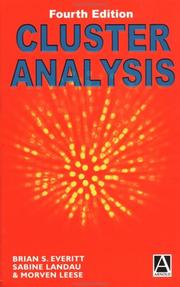
- 📕Cluster AnalysisBrian S. Everitt, Sabine Landau · 2009
 High Performance Cluster ComputingRajkumar Buyya · 1999
 Grade models and methods for data analysisTeresa Kowalczyk · 2004
Ranked by number of editions on Open Library, a rough measure of how lasting a book is.
🔗 Related topics
- Automatic clustering algorithms Automatic clustering algorithms are algorithms that can perform clustering without prior knowledge of data sets. In contrast with other clustering techniques…
- K-means clustering k-means clustering is a method of vector quantization, originally from signal processing, that aims to partition n observations into k clusters in which…
- DBSCAN Density-based spatial clustering of applications with noise (DBSCAN) is a data clustering algorithm proposed by Martin Ester, Hans-Peter Kriegel, Jörg…
- Hierarchical clustering In data mining and statistics, hierarchical clustering (also called hierarchical cluster analysis or HCA) is a method of cluster analysis that seeks to…
- K-medoids The k-medoids method is used in unsupervised learning. It is a classical partitioning technique of clustering that splits a data set of n objects into…
- ELKI ELKI (Environment for Developing KDD-Applications Supported by Index-Structures) is a data mining (KDD, knowledge discovery in databases) software framework…
- BIRCH BIRCH (balanced iterative reducing and clustering using hierarchies) is an unsupervised data mining algorithm used to perform hierarchical clustering over…
- OPTICS algorithm Ordering points to identify the clustering structure (OPTICS) is an algorithm for finding density-based clusters in spatial data. It was presented in 1999…